
Quick answer: In India the fire NOC (now usually called a fire safety certificate) belongs to the building, but your office fit-out can affect it. Under NBC 2016, adding partitions or cubicles over 500 m² in a building 15 m or taller needs local fire authority approval, and no alteration may lower fire safety. State laws add renewals and checks.
Most companies only think about the fire NOC when the landlord asks for fire drawings or a fire officer visits after move-in. By then the cabins are built, the ceiling is closed and the sprinklers are in the wrong places.
This guide explains when an office interior needs fire approval, what the National Building Code of India 2016 (NBC) says about partitions, ceilings and exits, and how the rules differ in Gujarat, Maharashtra, Delhi, Haryana and Karnataka.
What is a fire NOC, and does an office tenant need one?
A fire NOC (no objection certificate) is the fire department’s approval that a building’s fire and life-safety measures meet the rules. Many states now call it a fire safety certificate; Gujarat’s portal describes it as “earlier called Fire NOC”. It usually comes in two stages: the fire layout is approved with the building plans, then the installed systems are inspected before occupation. The Delhi Fire Service works this way.
On a leased floor, the certificate is normally held for the whole building by the owner. You rarely apply for a fresh NOC yourself, but three things still apply to you:
- Your fit-out must not undo the building’s approval. It was issued for a set layout of sprinklers, detectors, exits and fire-rated walls.
- Large changes in tall buildings need fresh approval. NBC 2016 sets the trigger, explained in the next section.
- Occupiers carry legal duties too. Maharashtra’s 2006 fire act, for example, places duties on the owner or occupier to keep fire systems in good repair at all times.
Under NBC 2016, offices fall under Group E (Business). Offices are E-1; IT parks and call centres are E-3. The NBC is a model code from the Bureau of Indian Standards (BIS). It becomes binding when states adopt it in their bye-laws, and the Directorate General of Fire Services asked all states in April 2017 to adopt NBC 2016 Part 4 (Fire and Life Safety).
When does an office fit-out need fire authority approval?
The key rule is clause 3.2.7 of NBC 2016 Part 4, on existing buildings. It says alterations and renovations must conform to the safety requirements for new buildings and “shall not in any way bring down level of fire and life safety below that which existed earlier”. It then adds: “Any addition or alterations or construction of cubicles or partitioning, for floor area exceeding 500 m² for all high rise buildings shall be with the approval of local fire authority.”
Two definitions make this practical:
- High-rise building: 15 m or above in height. Most Grade-A towers in BKC, Cyber City, Whitefield or on SG Highway are well above that.
- 500 m² is about 5,380 sq ft. A 10,000 sq ft office with new cabins on the 8th floor of a tower is clearly inside the rule.
States set their own NOC thresholds. Delhi’s Fire Service Rules, 2010 (Rule 27) cover business buildings over 15 m or with five or more storeys, and Karnataka’s 2023 amendment requires NOCs for high-rise buildings of 21 m and above. Check your city’s rule before assuming either way.
BIS circulated draft chapters of a revised NBC for comment in 2025, but NBC 2016 remains the current code.
What do NBC 2016 rules mean for your layout and materials?
Even when no separate approval is needed, these NBC 2016 clauses shape an office design.
False ceilings must be non-combustible
Clause 3.3.4 says the false ceiling, “including all fixtures used for its suspension”, must be of non-combustible material. In practice that means mineral fibre, gypsum or metal ceilings on metal suspension, not plywood or MDF.
Wall finishes and panelling have flame-spread limits
Clause 3.4.11 sets four flame-spread classes for finishes. Class 1 can be used anywhere; Class 2 anywhere except facades, staircases and corridors. Panelling is allowed only in a limited area, which affects wood feature walls in receptions and corridors.
Exits, travel distance and occupant load
For business buildings, NBC 2016 uses an occupant load of 10 m² per person (gross area) and a maximum travel distance to an exit of 30 m, which may be increased by 50% in a fully sprinklered building. Every office floor needs at least two exits, and exit doorways must be at least 1,000 mm wide and 2,000 mm high.
Access-controlled doors must release in a fire
Access-controlled and electromagnetic doors on exit routes must unlock automatically when the sprinkler or fire alarm system activates, and on loss of power, with a manual PUSH TO EXIT release. It is a common gap when a separate IT vendor installs access control.
Wiring, ducts and compartments
Medium and low voltage wiring inside the false ceiling must run in metal conduit, and any 230 V wiring above the false ceiling needs 660 V grade insulation. Fire dampers are needed where ducts cross fire separation walls and at each compartment’s air inlets; in sprinklered business buildings a compartment can be up to 3,000 m².
The table below links common fit-out changes to the fire items they touch.
| Fit-out change | What it affects | NBC 2016 Part 4 reference | What to do |
|---|---|---|---|
| New cabins, meeting rooms or partitions | Sprinkler and detector coverage, exit routes | Cl. 3.2.7; Table 5 (travel distance) | Revise the fire layout; get fire authority approval if high-rise and over 500 m² |
| New or replaced false ceiling | Combustibility, sprinkler and detector positions | Cl. 3.3.4 | Use non-combustible ceilings and suspension; coordinate sprinkler drops |
| Wood panelling and feature walls | Flame spread on walls and corridors | Cl. 3.4.11 | Choose the right surface class; keep panelling limited |
| More desks on the same floor | Occupant load, exit capacity | Table 3 (10 m² per person for business) | Check exit widths and number of exits |
| Access control on exit doors | Escape in a fire or power cut | Cl. 4.4.2.4 (access-controlled doors) | Fire alarm interface, fail-safe locks, PUSH TO EXIT release |
| New cabling, AC ducts or core cuts | Fire separation and compartment integrity | Cl. 3.4.8.4 (dampers); wiring rules | Metal conduit, fire dampers, fire-stopping of every penetration |
How do fire NOC rules differ in Gujarat, Maharashtra, Delhi, Haryana and Karnataka?
Fire services are a state subject, so the paperwork changes by state.
| State | Main law | Who approves and renews | What it means for your fit-out |
|---|---|---|---|
| Gujarat (Ahmedabad, GIFT City, Surat, Vadodara) | Gujarat Fire Prevention and Life Safety Measures Act, 2013 | State fire officials issue plan approval and the first fire safety certificate (valid 3 years); renewals every 2 years are done by an enrolled Fire Safety Officer (FSO) through the GujFireSafety CoP portal | Six-monthly inspections and mock drills by the FSO will check your floor; keep fire drawings ready |
| Maharashtra (Mumbai, Pune, Navi Mumbai) | Maharashtra Fire Prevention and Life Safety Measures Act, 2006 | Chief Fire Officer of the local authority; a licensed agency certifies fire systems | Owner or occupier submits a licensed-agency certificate on Form B every January and July |
| Delhi | Delhi Fire Service Act, 2007 and Delhi Fire Service Rules, 2010 | Delhi Fire Service; NOC needed for business buildings over 15 m or with five or more storeys | From 24 August 2026, certificates stay valid unless suspended or cancelled, with a yearly Form K declaration |
| Haryana (Gurgaon) | Haryana Fire and Emergency Services Act, 2022 | Director of fire services or an authorised officer; certificate valid 3 years for business and special buildings | Annual self-declaration that there is no addition or alteration; alterations beyond permitted limits end the certificate |
| Karnataka (Bengaluru) | Karnataka Fire Force Act, 1964 (amended 2023) | Karnataka State Fire and Emergency Services | NOC needed for high-rise buildings of 21 m and above, following NBC 2016 |
Gujarat: Ahmedabad and GIFT City
Gujarat runs fire approvals online through the GujFireSafety Compliance Portal. Renewals, six-monthly inspections and mock drills are done by state-enrolled Fire Safety Officers, so on SG Highway or in GIFT City the next FSO visit will see your floor. See how our Ahmedabad office interiors team handles landlord-approved drawings in Grade-A towers.
Maharashtra: Mumbai and Pune
Under the Maharashtra Fire Prevention and Life Safety Measures Act, 2006, a licensed agency certifies the fire installations, and a maintenance certificate is filed every January and July. In BKC, Lower Parel or Powai, plan fire work so the agency can sign off your floor in the next cycle.
Delhi and Gurgaon
In Delhi, amendment rules notified in 2025 mean that from 24 August 2026 a certificate stays valid unless suspended or cancelled, with a yearly Form K declaration and a ₹1,000 fee. In Gurgaon, the Haryana Fire and Emergency Services Act, 2022 requires a yearly self-declaration of “no addition/alteration in the building”. An alteration beyond the Haryana Building Code, 2017 limits ends the certificate and needs a revised fire-fighting scheme, so on Golf Course Extension Road fire drawings are part of the fit-out. Our Gurgaon office interiors team plans for this.
How much does fire compliance add to an office fit-out budget?
No Indian benchmark publishes fire protection separately, only the share of MEP services (mechanical, electrical and plumbing, which includes HVAC, electrical, fire and UPS). JLL’s Asia Pacific Fit-Out Cost Guide 2025 put MEP at 29% of office fit-out cost in India. Applied to Cushman & Wakefield’s 2026 rates, that gives the envelope fire work sits in.
| City | All-in fit-out (₹/sq ft, C&W 2026) | MEP share at 29% (≈ ₹/sq ft) | MEP on a 10,000 sq ft office (≈ ₹) |
|---|---|---|---|
| Mumbai | 6,567 | 1,900 | 1.9 crore |
| Delhi | 6,207 | 1,800 | 1.8 crore |
| Bengaluru | 6,027 | 1,750 | 1.75 crore |
| Ahmedabad, Pune, Hyderabad, Chennai, Kolkata | 5,847 | 1,700 | 1.7 crore |
What moves the fire part of that number:
- Shell condition. A warm shell with an existing sprinkler grid needs drops and relocation; a bare shell may need new branch lines.
- Number of rooms. Every cabin and meeting room adds sprinkler heads and detectors.
- Doors. Certified fire-rated doors and alarm-linked access control cost more than plain doors.
- Server rooms. NBC 2016 points E-3 spaces to detection plus clean agent or similar suppression.
- Approvals and testing. Fire drawings, testing and liaison. Compare bids including 18% GST on works contracts.
For the full city-by-city budget picture, see our guide to office interior cost per sq ft in India.
How does fire approval fit into a 6–8 week office fit-out programme?
Most Quick Furnish office fit-outs are handed over in 6 to 8 weeks from design sign-off. Fire work only fits in that window if it starts on day one:
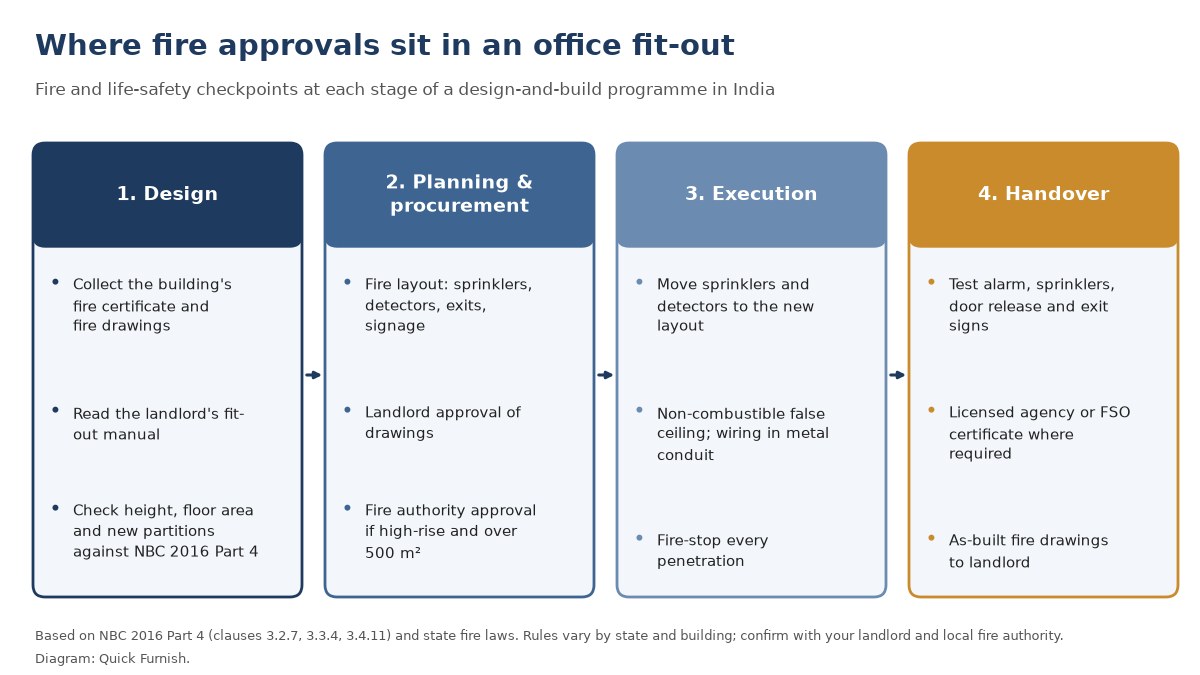
- Design. Collect the building’s fire certificate, fire drawings and fit-out manual. Check height, floor area and partitions against clause 3.2.7 and the state rule.
- Planning and procurement. Draw the fire layout with the GFC (good-for-construction) drawings and BOQ. Submit to the landlord, and to the fire authority where needed.
- Execution. Move sprinklers and detectors as partitions go up, and fire-stop every penetration before the ceiling closes.
- Handover. Test the alarm, sprinklers, door release and exit signs with the building team, and hand over as-built fire drawings for the next renewal or declaration.
What fire-safety mistakes do companies make during office fit-outs?
Check this list before you approve a design or a contractor’s BOQ:
- Assuming the landlord’s NOC covers anything you build. Large partitioning in a high-rise needs its own approval.
- Building cabins first and moving sprinklers later. Every new room changes coverage.
- Using plywood or MDF false ceilings. NBC 2016 requires non-combustible ceilings.
- Covering corridors in wood panelling. Corridors have stricter flame-spread limits.
- Locking exit doors with access control that does not release. Exit locks must open on alarm and power failure.
- Adding desks without checking exits. Denser than 10 m² per person needs an exit check.
- Leaving cable and duct holes unsealed. Every penetration needs fire-stopping.
- Skipping as-built fire drawings. Without them, the next renewal becomes a dispute.
Case study: a 9,500 sq ft TotalEnergies office at Adani Shantigram, Ahmedabad
Quick Furnish delivered a 9,500 sq ft office for TotalEnergies at Adani Shantigram, Ahmedabad on a design and build contract, with a 6 to 8 week timeline. The brief was a clean workspace reflecting a global energy brand and international standards.
On a project like this, a global client’s guidelines, the landlord’s rules and Gujarat’s fire regime all apply at once. Under one contract, the same team draws the partitions, ceiling and fire layout, so the drawings the landlord reviews are the ones that get built.
Across more than 600 projects in 35+ cities, our design and build services include MEP with fire safety, fire detection and NOC support, and help with landlord and building-management approvals. We follow the National Building Code and local fire approvals. Fire items are priced up front in an itemised BOQ.
Planning an office in a high-rise? Get a free test fit and quote or call +91 70437 04333.
Key takeaways
- The fire NOC or fire safety certificate is usually held for the whole building, but your fit-out must not reduce its level of fire safety.
- Under NBC 2016, partitions or cubicles over 500 m² (about 5,380 sq ft) in a building 15 m or taller need local fire authority approval.
- Non-combustible false ceilings, limited panelling, exit-route door release and fire-stopping are the NBC rules that most often affect office interiors.
- State rules differ: Gujarat uses FSO renewals, Maharashtra twice-yearly Form B, Delhi a yearly Form K from 24 August 2026, and Haryana a yearly no-alteration declaration.
- Draw the fire layout with the partition layout, and hand over as-built fire drawings.
Frequently asked questions about fire NOC for office fit-outs
Is a fire NOC required for an office in India?
For most office buildings above the state’s height or area threshold, yes, but it is usually held for the whole building by the owner or developer. Your fit-out must keep that approval valid.
Who applies for the fire NOC, the landlord or the tenant?
Usually the building owner or developer holds the fire NOC or fire safety certificate. Tenants still have duties under laws such as Maharashtra’s, and large alterations are usually approved through the landlord.
Do I need fire approval to add partitions or cabins to my office?
Under NBC 2016 clause 3.2.7, any addition, alteration, cubicles or partitioning over 500 m² of floor area in a high-rise building (15 m or taller) needs local fire authority approval. Smaller changes must still not lower fire safety.
What height counts as a high-rise for fire rules in India?
NBC 2016 defines a high-rise building as 15 m or above. States vary for NOC purposes: Karnataka requires a fire NOC for buildings of 21 m and above, and Delhi covers business buildings over 15 m or with five or more storeys.
How long is a fire safety certificate valid?
It depends on the state. In Gujarat, the first certificate lasts three years and renewals every two years. In Haryana, it is valid for three years for business buildings. In Delhi, from 24 August 2026, it stays valid unless suspended or cancelled, with a yearly Form K declaration.
Can I use a wooden false ceiling or wood panelling in my office?
NBC 2016 requires the false ceiling and its suspension fixtures to be non-combustible, so plywood or MDF ceilings are out. Panelling is allowed in a limited area and must meet the flame-spread class for its location.
Do access-controlled doors need to unlock in a fire?
Yes. Under NBC 2016, access-controlled doors on exit routes must unlock automatically when the fire alarm or sprinklers activate and on power failure, with a manual PUSH TO EXIT release.
How much does fire work cost in an office fit-out?
No Indian benchmark isolates fire work. It sits inside MEP, which JLL puts at 29% of Indian fit-out cost. On Cushman & Wakefield’s 2026 rates, that is about ₹1,700 to ₹1,900 per sq ft for all MEP, by our calculation; fire is one part of it.
Get a free test fit with the fire layout planned in
A test fit (a first layout of your team on your floor plan) is the moment to check partitions, exits and sprinklers. Share your floor area, headcount and move-in date, and within 48 hours we will send you a test fit and a realistic budget per sq ft, backed by a fixed, itemised BOQ.
Prefer to talk? Call +91 70437 04333 or email info@quickfurnish.co.
This guide summarises NBC 2016 Part 4 and state fire laws as checked in October 2026. It is general information, not legal advice. Fire rules change often and vary by building, so confirm requirements with your landlord and the local fire authority.