Quick answer: Cafe interior design in India typically costs ₹1,500 to ₹5,000 per sq ft for the fit-out alone, depending on format, before kitchen equipment, exhaust, air conditioning and GST. The layout is shaped as much by FSSAI hygiene rules, the fire department and the gas installation as by the look, so plan the kitchen first.
India’s food services market was worth about ₹5.69 lakh crore in FY24 and is expected to reach ₹7.76 lakh crore by FY28, according to the National Restaurant Association of India’s India Food Services Report 2024. The organised segment, which includes chains and branded cafes, is growing faster, at about 13% a year. That growth shows up on site as a steady stream of new cafes, QSR outlets and cloud kitchens in malls, high streets and office campuses.
A cafe is a harder fit-out than an office of the same size. It has a wet, hot kitchen, a gas line, an exhaust duct that has to leave the building somewhere, and inspectors from the food, fire and municipal departments who will each look at the finished space. This guide covers what a cafe or restaurant interior includes, what it costs per sq ft, the licences that shape the design, a practical layout, a realistic programme and the mistakes we see most often.
What does cafe interior design include in India?
Cafe interior design is the full design and build of a food and beverage space: the dining area guests see, the kitchen and back-of-house they do not, and the services that keep both safe and compliant. On a turnkey contract it usually covers:
- Front of house: entrance and facade, ordering counter or barista bar, seating (loose chairs, banquettes, high tables), lighting, acoustic treatment, branding and menu boards, guest toilets.
- Back of house: kitchen zones, cold and dry storage, dishwash, staff changing area and a separate route for goods inward and waste out.
- MEP (mechanical, electrical and plumbing): kitchen exhaust hood and ducting, fresh-air make-up, air conditioning for the dining area, power for equipment, floor drains and a grease trap, water supply and purification.
- Gas and fire safety: the LPG or PNG installation, gas leak detection, extinguishers, detection and, where the building requires it, sprinkler changes.
- Approvals drawings: the layout and services drawings the landlord, fire department and municipal licensing office ask for.
Kitchen equipment (ranges, fryers, coffee machines, refrigeration) is often bought by the operator directly, but the interior has to be designed around it. The equipment list should be fixed before the drawings are, because it decides power loads, drain points, the hood size and the duct route.
How much does a cafe or restaurant interior cost in India?
There is no official benchmark for food and beverage fit-outs in India in the way there is for offices. The most detailed published set of planning ranges we found is InteriorCalculator’s 2026 India cost models for cafes and restaurants. The table below uses its fit-out-only ranges per sq ft of carpet area and applies them to a 1,000 sq ft unit so you can compare formats.
| Format | Fit-out only (₹ per sq ft) | 1,000 sq ft unit, fit-out only | What drives the number |
|---|---|---|---|
| Cloud kitchen | ₹1,200–1,800 | ₹12–18 lakh | Kitchen finishes, exhaust and drainage; almost no dining area |
| Neighbourhood cafe | ₹1,500–2,200 | ₹15–22 lakh | Simple counter, loose furniture, standard lighting |
| QSR / takeaway | ₹1,800–2,800 | ₹18–28 lakh | Durable finishes, queue and counter design, brand fixtures |
| Standard branded cafe | ₹2,200–3,200 | ₹22–32 lakh | Designed barista bar, feature ceiling, branded joinery |
| Casual dining restaurant | ₹2,500–3,800 | ₹25–38 lakh | Larger kitchen, booths, acoustic ceiling, themed finishes |
| Speciality cafe or roastery | ₹3,200–5,000 | ₹32–50 lakh | Custom bar, roasting equipment area, feature design |
| Fine dining | ₹3,500–6,000 | ₹35–60 lakh | Bespoke furniture, stone and veneer, designed acoustics and lighting control |
Those extras are not small. In the same source’s default example, a 700 sq ft, 30-seat standard cafe comes to about ₹17–25 lakh for the fit-out alone, but ₹31–60 lakh once equipment, exhaust, air conditioning, fire safety, signage, licences, design fees, contingency and 18% GST are added. That is roughly ₹4,400 to ₹8,500 per sq ft all-in. Budget for the whole project, not the fit-out line.
Why GST on the fit-out is usually a real cost for a cafe
Works contract services, which cover most interior fit-outs, carry 18% GST. Since the GST rate changes of 22 September 2025, standalone restaurant services are taxed at 5% without input tax credit. In practice, most standalone cafes and restaurants cannot set the GST paid on their fit-out against the GST they collect, so the 18% becomes part of the project cost. Restaurants in hotels with room tariffs that fall under the “specified premises” rules are treated differently. Check your position with your CA before you fix the budget.
An itemised BOQ (bill of quantities) is the only way to compare quotes for a cafe fairly, because one bidder may include the exhaust, gas line and grease trap and another may not. Our guide to reading an interior BOQ explains how to check for missing lines.
Which licences and approvals shape a cafe’s interior design?
Several approvals depend directly on how the space is built. The names and thresholds vary by state and city, so treat the list below as the checklist to confirm locally, not a substitute for it.
FSSAI registration or licence
Every food business needs FSSAI registration or a licence. From 1 April 2026, FSSAI raised the thresholds: registration now covers turnover up to ₹1.5 crore, a State licence applies up to ₹50 crore and a Central licence above that. Registrations and licences now have perpetual validity instead of periodic renewal. For the designer, the more important document is Schedule 4 of the licensing regulations. Its catering section asks for floors that are non-slippery, impervious and sloped to drains, walls with smooth, washable surfaces, sealed ceilings, insect-proof screens on openings, and ventilation that does not carry air from dirty areas to clean ones.
Municipal health or trade licence
Most cities also license eating houses through the municipal corporation. In Mumbai, an eating house needs a licence under Section 394 of the Mumbai Municipal Corporation Act from the MCGM health department, and the Mumbai Fire Brigade issues fire compliance for it. In Delhi, the police eating house licence was withdrawn in June 2025, and licensing now rests with local bodies such as the MCD and NDMC.
Fire NOC and NBC 2016
The National Building Code 2016 treats restaurants as assembly occupancies (Group D), which carry stricter exit and fire safety requirements than offices. Whether a separate fire NOC is needed depends on the state. Delhi Fire Service, for example, has said that restaurants with a gross floor area of 90 sq m (about 970 sq ft) or more fall under its rules, as noted in a 2019 Delhi Excise order. Other states use seating capacity, building height or floor area. Our fire NOC guide for office interiors explains how partitions and ceilings change sprinkler and detector layouts, and the same logic applies to a cafe.
Gas installation
Under the Gas Cylinders Rules, 2016, storing more than 100 kg of LPG in cylinders generally needs a storage licence from PESO (Petroleum and Explosives Safety Organisation), as PESO’s FAQ explains. Most small cafes stay under that limit or use piped natural gas (PNG) where the building has it. Either way, the cylinder bank or gas meter, pipe route and leak detection need to be on the drawings from day one.
A bar licence from the state excise department is a separate process with its own layout requirements. If alcohol is in the plan, get that advice before the design is fixed.
How should a cafe kitchen and dining area be laid out?
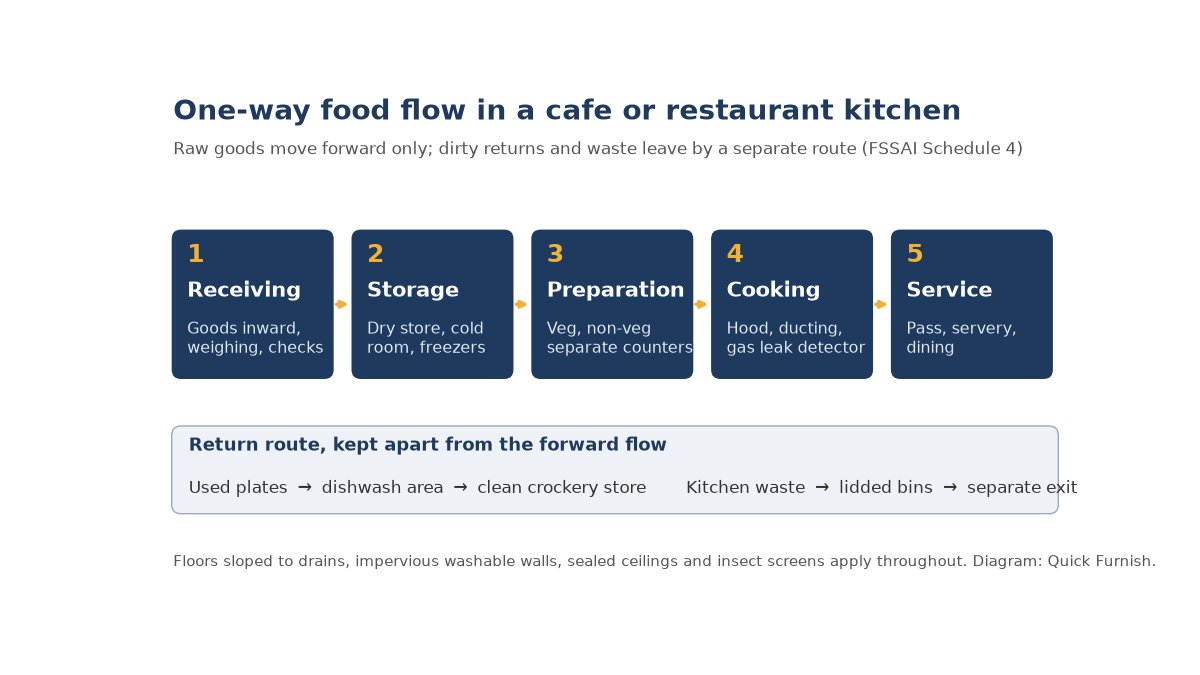
Start with the kitchen. A dining room can be adjusted late; a kitchen exhaust route or floor drain usually cannot. The FSSAI principle is one-way flow: food moves forward from receiving to storage, preparation, cooking and service, while used crockery and waste leave by a separate route.
The Mumbai Fire Brigade’s codified requirements for eating houses show how specific the fire side can get. For a single-LPG-cylinder kitchen they include:
- A kitchen room of at least 150 sq ft.
- The cylinder under the RCC kitchen platform, behind perforated metal doors.
- A metal hood over the burners, connected to ducting whose outlet extends at least one metre above the structure.
- An LPG leak detector near the gas installation that raises an alarm.
- A clear passage at least one metre wide from the entrance to the rear of the premises.
- No kitchen under an approved loft or mezzanine.
Other cities have their own versions, but the pattern is the same: kitchen size, gas location, exhaust route and clear escape paths are fixed by rules, and the design has to start from them.
Front of house
- Counter and queue: place the ordering counter so the queue does not block the entrance or the escape route, and keep the pick-up point separate from the order point in busy formats.
- Seating mix: combine loose tables (flexible), banquettes (more covers per sq ft) and a few high tables or a window bar for solo guests.
- Acoustics: hard floors, glass and exposed ceilings make cafes loud. Add acoustic panels, baffles or upholstered seating early rather than after complaints.
- Durability: table tops, chair legs and counter fronts take far more wear than office furniture. Choose finishes that can be cleaned daily with the chemicals the kitchen uses.
How long does a cafe fit-out take?
Quick Furnish’s process runs in four stages: Design, Planning & Procurement, Execution and Handover. Most of our office fit-outs are handed over in 6 to 8 weeks once drawings and the BOQ are approved. Food and beverage projects need extra time for approvals and equipment. InteriorCalculator’s models estimate 6 to 12 weeks for a cafe and 8 to 16 weeks for a restaurant after drawings and landlord approvals. A typical sequence is:
- Weeks 1–2: menu and equipment list, test fit, kitchen layout, landlord fit-out manual review.
- Weeks 2–4: design approval, BOQ, services drawings, landlord and fire submissions, equipment orders.
- Weeks 4–10: civil work, waterproofing, MEP, exhaust ducting, gas line, ceilings, joinery and finishes.
- Weeks 10–12: equipment installation, testing, snagging (fixing small defects), inspections and FSSAI documentation.
The programme above is an example, not a promise. Exhaust routes through a mall’s service shaft, a society’s approval for a duct on the facade or imported coffee equipment can each add weeks, which is why they belong in the first fortnight, not the last.
Mall, high street or office campus: which location suits your cafe?
Where the cafe sits changes the fit-out more than most operators expect. The table compares the three most common settings in Indian cities.
| Factor | Mall | High street (e.g. Bandra, Indiranagar, CG Road) | Office campus or IT park |
|---|---|---|---|
| Who approves the design | Mall fit-out manual and mall projects team | Building owner or society; municipal and fire authorities | Landlord’s fit-out manual and facility team |
| Exhaust and gas | Usually a central kitchen exhaust shaft; gas policy set by the mall (often PNG or electric only) | You find the duct route yourself; neighbours and society may object | Shaft or approved route; many campuses restrict LPG |
| Working hours on site | Mostly night work while the mall is open | Day work, subject to local rules | Restricted hours in occupied buildings |
| Footfall pattern | Weekends and evenings | Depends on the street | Weekday office hours |
| Fit-out risk | Strict specs and penalties for delays | Approvals and neighbour issues | Shared services and security processes |
If you are leasing in Mumbai, our Mumbai commercial interiors team works across BKC, Lower Parel, Powai and Navi Mumbai, where building rules and working-hour limits differ from tower to tower.
8 cafe fit-out mistakes Indian operators make
1. Designing the dining room before the kitchen
The kitchen fixes the exhaust, drains, gas and power. Start there, then fit the seating around it.
2. Signing the lease before checking the exhaust route
If the hood duct cannot leave the building legally, the unit does not work as a cooking cafe. Confirm the route with the landlord in writing before signing.
3. Budgeting only the fit-out line
Equipment, exhaust, air conditioning, signage, licences, design fees, contingency and 18% GST can double the fit-out number.
4. Assuming GST on the fit-out can be recovered
Most standalone restaurants pay 5% GST without input tax credit, so GST on works is usually a cost. Ask your CA.
5. Choosing finishes that cannot be cleaned
FSSAI Schedule 4 expects impervious, washable surfaces in food areas. Porous stone, raw wood and open joints in the kitchen create inspection problems.
6. Leaving fire and gas drawings to the end
Fire NOC rules, the gas installation and leak detection affect the layout. Fix them at design stage.
7. Ignoring acoustics
A loud room shortens dwell time. Plan acoustic panels or soft finishes in the ceiling design.
8. Not standardising for the second outlet
If you plan to grow, document the design as a kit of parts (counter, seating modules, lighting, signage) so the next outlet is faster and cheaper to build.
How Quick Furnish delivers cafe and restaurant interiors
Quick Furnish designs and builds cafes and restaurants alongside offices, co-working floors, retail, hotels and healthcare spaces, under one contract with one programme and one point of accountability. You approve the drawings and an itemised BOQ before procurement starts, and any change is priced and approved by you first. Read more about our design and build services.
Case study: Opulence, a standardised design rolled out across India
Our Opulence project was an office, not a cafe, but it shows the discipline a growing cafe chain needs. The brief was to standardise the design, repeat it on every floor and scale it across the network. We delivered the project in under 45 days, and Opulence then gave us its pan-India office rollouts. The same approach, a fixed design kit, a repeatable BOQ and one team accountable for every site, is what keeps a cafe brand’s fifth outlet as consistent as its first.
Get a free test fit & quote. Share your carpet area, seat target, menu type and opening date. Within 48 hours we will send you a test fit and a realistic budget per sq ft. Contact us or call +91 70437 04333.
Key takeaways
- Cafe and restaurant fit-outs in India typically run ₹1,500–5,000 per sq ft for the fit-out alone, with cloud kitchens lower and fine dining higher (InteriorCalculator, 2026).
- All-in project costs, including equipment, services, fees and GST, are often double the fit-out figure.
- Most standalone restaurants pay 5% GST without input tax credit, so 18% GST on fit-out works is usually a real cost.
- FSSAI thresholds changed on 1 April 2026: registration up to ₹1.5 crore turnover, State licence up to ₹50 crore.
- Design the kitchen first: one-way food flow, washable finishes, a legal exhaust route and the gas installation fix the rest of the plan.
- Fire NOC triggers vary by state, so confirm them for your city before the layout is frozen.
Frequently asked questions about cafe interior design in India
How much does a cafe interior cost per sq ft in India?
Published 2026 planning ranges put the fit-out alone at about ₹1,500–2,200 per sq ft for a simple neighbourhood cafe, ₹2,200–3,200 for a standard branded cafe and ₹3,200–5,000 for a speciality cafe, excluding GST. Equipment, exhaust, air conditioning, licences and fees are extra.
What is the total cost to set up a 1,000 sq ft cafe?
At standard cafe rates, the fit-out alone would be about ₹22–32 lakh. With kitchen equipment, exhaust, air conditioning, signage, licences, design fees, contingency and GST, the total is often around double that. Rent deposits and working capital are separate. A test fit and BOQ give you a firm number.
Which licences does a new cafe need in India?
At minimum, FSSAI registration or a licence, a municipal health or trade licence, a fire NOC or fire compliance where your state requires it, and GST registration. Signage, music and liquor need separate permissions. Requirements differ between cities, so confirm the list locally.
What changed in FSSAI licensing in 2026?
From 1 April 2026, FSSAI registration covers turnover up to ₹1.5 crore (earlier ₹12 lakh), State licences cover up to ₹50 crore, and Central licences apply above that. Registrations and licences also have perpetual validity, so periodic renewal is no longer needed.
Does a small cafe need a fire NOC?
It depends on the state and the building. Some states set the trigger by seats, others by floor area or building height. Delhi Fire Service, for example, covers restaurants of 90 sq m or more. Mumbai issues fire compliance with the eating house licence. Check with your state fire service at design stage.
How long does a cafe fit-out take?
Usually 6 to 12 weeks for a cafe and longer for a full-service restaurant, after drawings and landlord approvals. Exhaust routes, gas approvals and imported equipment are the usual causes of delay, so plan them in the first two weeks.
Can GST on cafe interiors be claimed back?
Usually not. Standalone restaurant services are taxed at 5% without input tax credit, so most cafes cannot offset the 18% GST charged on fit-out works. Restaurants in specified hotel premises are treated differently. Confirm with your CA.
Do you design cafes outside Ahmedabad, Mumbai and Gurgaon?
Yes. Quick Furnish has its head office in Ahmedabad and hubs in Mumbai and Gurgaon, and works in 35+ cities across 12+ states. Share your location, carpet area and opening date for a free test fit and quote.
Plan your cafe before you sign the lease
Share your carpet area, seat target, menu type and opening date, and within 48 hours we will send you a test fit and a realistic budget per sq ft. If you are choosing between two units, send both plans and we will tell you which one takes a compliant kitchen more easily.
Prefer to talk? Call +91 70437 04333 or email info@quickfurnish.co.
Cost ranges, licence thresholds and fire rules in this guide were checked in November 2026 against the named sources. They are guides, not quotes or legal advice. Confirm local requirements with your landlord, the licensing authorities and your CA.