
Quick answer: Coworking fit-out cost in India usually runs about ₹1,350 to ₹2,600 per sq ft of leasable area, based on figures published for Smartworks, WeWork India and CBRE’s flex-centre models. At 60 sq ft per desk, that is roughly ₹80,000 to ₹1.5 lakh per seat. Payback depends mostly on occupancy, rent and how much the landlord funds.
India now has more flexible office space than any other Asia-Pacific market by penetration. Colliers counts 72.3 million sq ft of Grade A flex stock across the top seven cities in 2025, about 8.5% of office stock, and expects it to pass 100 million sq ft by 2027. A FICCI–CBRE report released in March 2026 puts total flex stock at 110 to 114 million sq ft. JLL says flex operators took 21.5% of all office leasing in 2025.
For an operator, every one of those centres starts as a bare or warm-shell floor and a fit-out budget. This guide sets out what a co-working fit-out includes, what it costs per sq ft and per seat, how many desks a floor can safely hold, how the lease model changes who pays, and the payback arithmetic that sits behind it.
What does a co-working fit-out include?
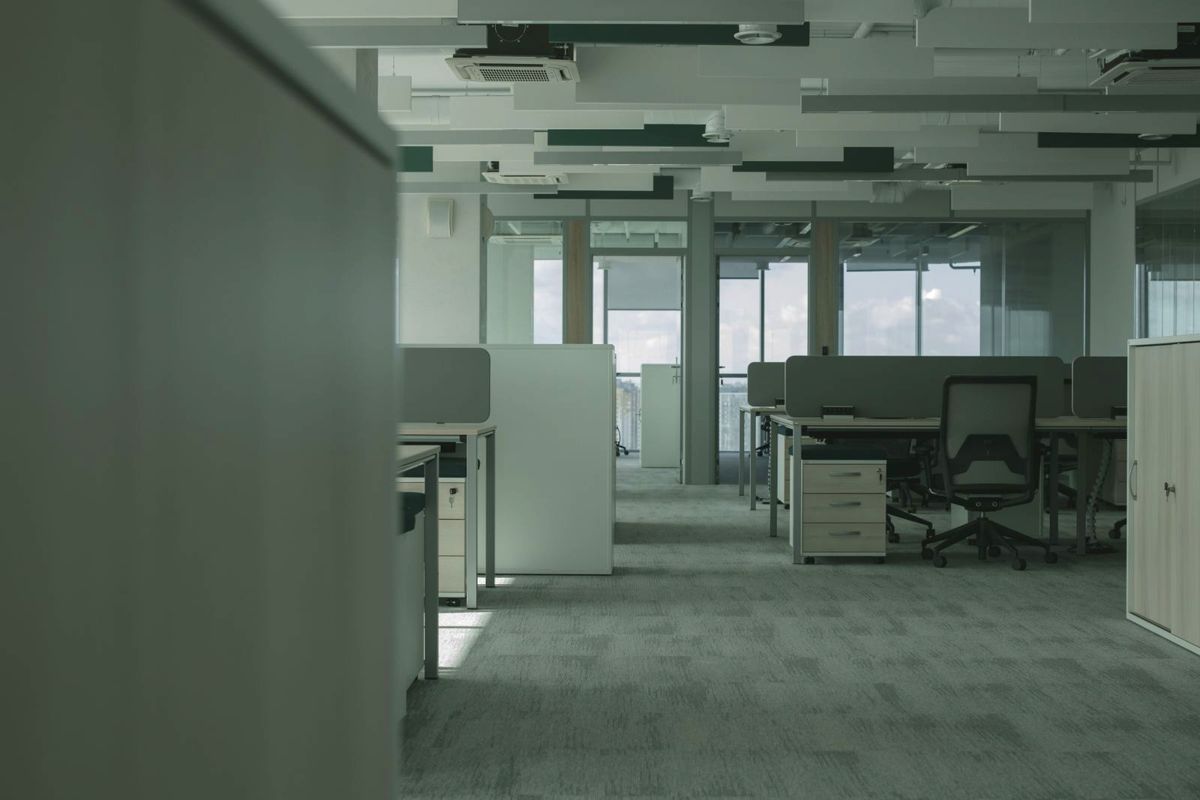
A co-working fit-out is the full interior build that turns a leased shell floor into a centre you can sell by the seat: open desks, private cabins, meeting rooms, phone booths, a reception and lounge, a pantry or café, and the services that keep a dense floor comfortable. In a turnkey contract it usually covers:
- Civil and interiors: gypsum and glass partitions, false ceilings, flooring, joinery, acoustic panels and branding walls.
- MEP (mechanical, electrical and plumbing): HVAC modification for higher density, lighting, raw and UPS power to every desk, pantry plumbing.
- Fire and life safety: extending sprinklers and detectors to the new layout, exit signage, emergency lighting and the drawings for the fire department.
- IT and security: structured cabling, Wi-Fi, access control, CCTV and meeting-room AV.
- Furniture: workstations, task chairs, cabin and meeting furniture, lounge and café seating, lockers.
The scope looks like an office fit-out, but the brief is different. An office is designed for one company’s teams. A co-working floor is designed for turnover: modules that can be resold as 4-seat, 10-seat or 50-seat suites, cabins that can be merged, and finishes that survive heavy daily use.
How much does a coworking fit-out cost in India?
There is no official rate card, but listed operators and brokers have published enough data to set a realistic band. Figures are per sq ft of leasable area unless stated.
| Benchmark | Fit-out capex | Per desk | Published by |
|---|---|---|---|
| Smartworks (managed offices, standardised modules) | About ₹1,350 / sq ft | Not stated | CARE Ratings, Nov 2025 |
| Awfis (mostly landlord-funded managed aggregation) | Not stated | About ₹50,000 / seat (FY22 to Dec 2023) | Awfis IPO note, Axis Capital |
| Top Indian operators, 2023 range | Not stated | ₹80,000 to ₹2 lakh / seat | Awfis IPO note, Axis Capital |
| CBRE model for a typical flex centre | ₹2,200 / sq ft | About ₹1.32 lakh at 60 sq ft / desk* | CBRE via Ambit Capital, Dec 2025 |
| WeWork India, FY25 | ₹2,363 / sq ft | ₹1.47 lakh / desk | WeWork India IPO note, Chola Securities |
| WeWork India, Q1 FY26 | Not stated | ₹1.33 lakh / desk | WeWork India IPO note, Chola Securities |
| CBRE model for a typical flex centre | ₹2,400 / sq ft | About ₹1.44 lakh at 60 sq ft / desk* | CBRE via JM Financial, Mar 2026 |
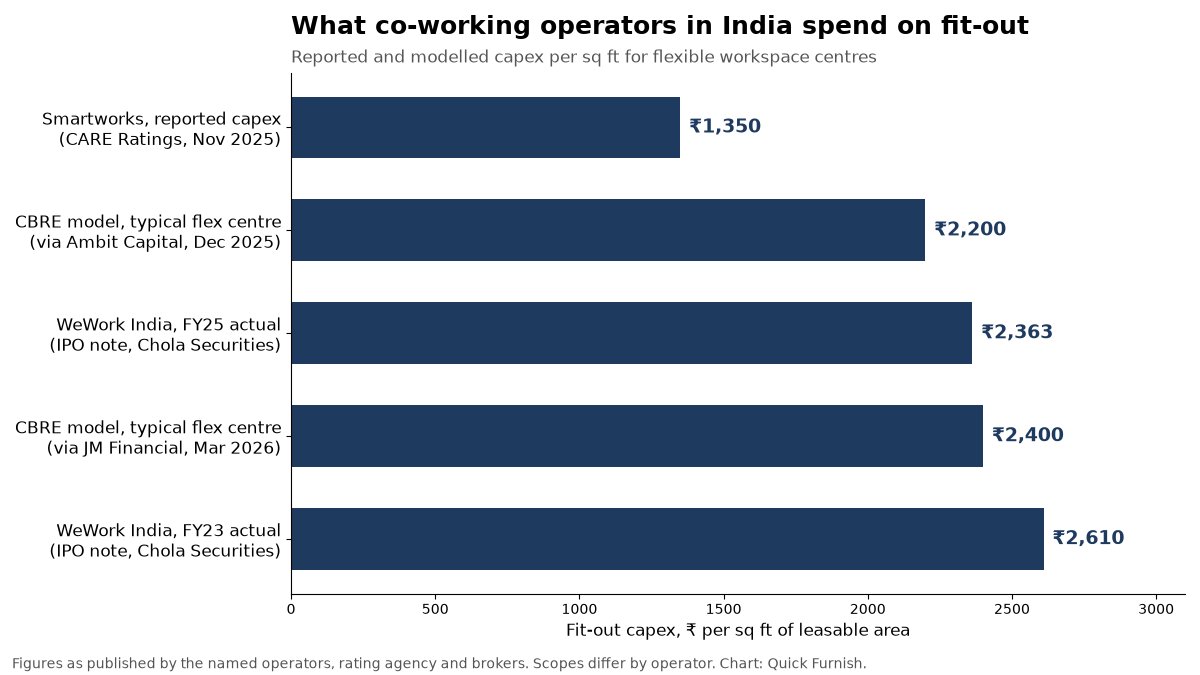
Why are these numbers well below corporate office benchmarks? Cushman & Wakefield’s APAC Office Fit-Out Cost Guide 2026 puts an all-in collaborative-hybrid corporate office at about ₹5,847 per sq ft in Ahmedabad, Pune, Hyderabad, Chennai and Kolkata and ₹6,567 in Mumbai (see our city-wise office interior cost guide). The scopes are different. Operators standardise layouts and furniture across dozens of centres, buy at volume, reuse components, and often take warm-shell floors where the landlord has already built core services. Smartworks’ rating report credits exactly that: standardisation, modular design and reusable components.
A worked example for a 10,000 sq ft floor
At 60 sq ft per desk, a 10,000 sq ft leasable floor holds about 166 desks. Using the published rates:
| Capex rate | Total fit-out | Per desk (166 desks) |
|---|---|---|
| ₹1,350 / sq ft (Smartworks level) | About ₹1.35 crore | About ₹81,000 |
| ₹2,200 / sq ft (CBRE model, Dec 2025) | About ₹2.2 crore | About ₹1.32 lakh |
| ₹2,400 / sq ft (CBRE model, Mar 2026) | About ₹2.4 crore | About ₹1.44 lakh |
Your own number moves with specification, the share of cabins versus open desks, how much HVAC the landlord has already installed, and the city. Ask for an itemised BOQ (bill of quantities) so you can see which lines drive the rate, and check every quantity against the drawings before you sign.
How many seats can a co-working floor hold?
Seat density is the single biggest lever in co-working economics, because rent is paid per sq ft but revenue is earned per seat. WeWork India’s published figures show desk density tightening from 78 sq ft per desk in FY22 to 62 sq ft in FY23–FY25, and to 60 sq ft per desk by Q1 FY26. CBRE’s cost comparison (published by Ambit Capital) assumes 60 sq ft per seat in a flex centre against 80 sq ft per seat in a traditional office, because members share the reception, washrooms, pantry and meeting rooms.
Density has a ceiling, and it is set by fire safety, not by furniture. NBC 2016 Part 4 uses an occupant load of 10 m² (about 108 sq ft) gross per person for business occupancies, and the exits, stair widths and travel distances of the building were designed around that population. A floor planned at 60 sq ft per desk can hold far more people than the base-building design assumed. Before you lock a layout, check exit capacity against your real seat count with the landlord’s fire consultant, and expect the fire department to look at it when you apply for or renew the NOC. Our guide to the fire NOC for office interiors covers that process state by state.
Two more NBC triggers matter for operators. Part 4 applies to business buildings with more than 500 m² on any floor, which covers most Grade A towers. It also applies where a floor has more than 300 m² of incidental assembly use, which a large event space or café-lounge in a flagship centre can reach.
Straight lease, managed aggregation or your own office: which suits you?
Who pays for the fit-out depends on the deal. Awfis’s IPO documents describe the two operator models used in India. In a straight lease, the operator pays fixed rent and funds the whole fit-out. In managed aggregation, the landlord funds part or all of the fit-out and takes a revenue or profit share, often instead of a fixed rent. Awfis’s low capex per seat came from having about two-thirds of its seats under that model at December 2023.
| Straight lease (operator) | Managed aggregation (operator + landlord) | Traditional lease (occupier’s own office) | |
|---|---|---|---|
| Who funds the fit-out | Operator, in full | Landlord in part or full; operator pays the rest | Occupier, in full |
| Landlord’s return | Fixed rent, CAM, escalations | Revenue or profit share, sometimes with a minimum guarantee | Fixed rent, CAM, escalations |
| Typical term | 8 to 10 years with the landlord (Colliers, 2025) | Negotiated per deal | Usually a lock-in of a few years plus renewal options |
| Seat density used in CBRE’s comparison | 60 sq ft / seat | 60 sq ft / seat | 80 sq ft / seat |
| Fit-out risk | Operator carries it | Shared | Occupier carries it |
For companies deciding between a flex contract and their own fit-out, the same CBRE comparison is useful. For 100 seats over three years, it puts a traditional lease at about ₹7.7 crore, including roughly ₹1.8 crore of fit-out capex at ₹2,200 per sq ft on 8,000 sq ft, against about ₹6.1 crore for flex seats. That is around 20% lower on its assumptions. Past three years, or with a larger headcount, the answer can flip, which is why enterprises with a long horizon still build their own floors.
What payback should a co-working operator expect?
Payback is fit-out capex divided by the monthly margin a centre earns once it fills. CBRE’s flex-centre assumptions, published by JM Financial in March 2026, give a usable starting point:
- Fit-out: ₹2,400 per sq ft of leasable area, plus a five-month security deposit to the landlord.
- Rent ₹102, CAM (common area maintenance) ₹15 and operating cost ₹35 per sq ft per month, or ₹152 in total.
- Seat revenue at a 2.4× multiple of rent, with 85% stabilised occupancy.
If you read the 2.4× multiple as revenue on a fully let floor, that is about ₹245 per sq ft per month, or about ₹208 at 85% occupancy. After ₹152 of rent, CAM and opex, about ₹56 per sq ft per month is left. ₹2,400 of capex divided by ₹56 is roughly 43 months, or about three and a half years once the centre is full. This is our arithmetic on CBRE’s assumptions. It leaves out the ramp-up period, other income, tax and the deposit, so treat it as a sense check, not a forecast.
Ramp-up matters as much as capex. WeWork India’s IPO note says its centres typically break even at about 55.7% occupancy, within four to six months of launch. Every week the fit-out overruns is a week of rent with no members, so programme certainty is worth real money.
GST on the fit-out is mostly a cost, not a credit
Operators often assume they can offset the GST paid on their fit-out against the GST they charge members. For the building work, they usually cannot. Section 17(5)(d) of the CGST Act blocks input tax credit on goods and services used to construct immovable property on your own account. In October 2024 the Supreme Court’s Safari Retreats judgment opened a route for buildings used for renting, but the Finance Act 2025 amended the clause with effect from 1 July 2017, and CBIC notified the change from 1 October 2025. Credit on movable furniture and IT, and on qualifying plant and machinery, is treated differently, so ask your chartered accountant to split the BOQ before you finalise your capex model.
Seven fit-out mistakes co-working operators make
1. Planning desks before checking exits
A layout that works commercially can still fail on egress. Check exit capacity and travel distances against the real seat count before the test fit goes to sales.
2. Treating the café and event space as office area
A large lounge or event zone can count as incidental assembly use under NBC Part 4. Size exits, finishes and fire detection for it from the start.
3. Building bespoke joinery that cannot be reused
Operators who report the lowest capex standardise modules across centres. One-off joinery raises cost now and makes reconfiguration harder later.
4. Under-sizing HVAC and power for density
At 60 sq ft per desk, heat load, fresh-air demand and the number of power points per sq ft are well above a typical office. Confirm what the landlord’s HVAC can deliver before you sell the seats.
5. Skipping acoustics in cabins and phone booths
Members judge a centre by whether they can take a call in private. Partitions that stop at the false ceiling leak sound, so take them up to the slab or add acoustic barriers.
6. Modelling GST on the fit-out as recoverable
Under Section 17(5)(d), most civil and interior GST becomes part of the capex. Build that into the payback model, not into a hoped-for refund.
7. Signing the lease before pricing the floor
Column grids, ceiling height and the landlord’s fit-out manual change the desk count and the BOQ. Get a test fit and budget before you commit to the floor.
How Quick Furnish delivers co-working fit-outs
Quick Furnish designs and builds co-working spaces under the same design-and-build contract it uses for offices: one contract, one programme and one itemised BOQ that you approve before work starts. Its projects page lists 10+ co-working spaces among 600+ completed projects, and most fit-outs are handed over in 6 to 8 weeks.
For Nayara in Ahmedabad, Quick Furnish delivered a co-working floor built around a green theme. The design used biophilic elements and natural textures, and the layout balanced open areas for collaboration with zones for focused work. It is the kind of identity-led floor that helps a centre stand apart without a generic co-working look.
Bengaluru is India’s largest flex market, with 30 to 32 million sq ft of stock according to the FICCI–CBRE report. Quick Furnish’s Bengaluru team and its Ahmedabad, Mumbai and Gurgaon offices plan co-working fit-outs around each building’s landlord manual and fire approvals.
Planning a new centre? Get a free test fit and quote, or call +91 70437 04333.
Key takeaways
- Published co-working fit-out capex in India runs from about ₹1,350 to ₹2,600 per sq ft of leasable area.
- At 60 sq ft per desk, that is roughly ₹80,000 to ₹1.5 lakh per seat. Landlord-funded managed aggregation deals can bring the operator’s share down to about ₹50,000.
- Density drives revenue, but NBC 2016 exit capacity sets the limit, so check egress before you sell the seats.
- On CBRE’s assumptions, a stabilised centre pays back its fit-out in roughly three and a half years. Ramp-up speed and programme overruns shift that number.
- GST on civil and interior work is largely blocked under Section 17(5)(d), so model it as cost.
- Quick Furnish builds co-working floors under one contract and one BOQ, with most handovers in 6 to 8 weeks.
Frequently asked questions about co-working fit-out cost in India
How much does a co-working fit-out cost per sq ft in India?
Published figures put it at about ₹1,350 to ₹2,600 per sq ft of leasable area. Smartworks reports around ₹1,350, CBRE’s flex-centre models use ₹2,200 to ₹2,400, and WeWork India reported ₹2,363 in FY25. Specification, landlord-installed services and the cabin-to-desk mix move your number within that band.
What is the fit-out cost per seat for a co-working centre?
Awfis’s IPO documents put top Indian operators at ₹80,000 to ₹2 lakh per seat in 2023. WeWork India reported ₹1.33 lakh per desk in Q1 FY26. Awfis itself was near ₹50,000 because landlords funded much of its fit-out under managed aggregation.
How many sq ft per seat should a co-working space plan for?
Indian flex operators now plan around 60 sq ft per desk. WeWork India reported 60 sq ft by Q1 FY26, and CBRE’s comparison uses 60 sq ft for flex against 80 for a traditional office. Check that density against the building’s exit capacity under NBC 2016 before finalising.
How long does a co-working fit-out take?
Quick Furnish hands over most fit-outs in 6 to 8 weeks from design sign-off. Add time before that for the landlord’s drawing approval and any fire department submissions. WeWork India says its centres usually break even within four to six months of launch, so a delay costs real money.
Can a co-working operator claim GST input tax credit on the fit-out?
Mostly not for civil and interior work. Section 17(5)(d) of the CGST Act blocks credit on construction of immovable property, and the Finance Act 2025 amendment, in force from 1 October 2025 with effect from July 2017, overrode the Safari Retreats judgment. Movable furniture, IT and qualifying plant and machinery are treated differently, so take advice from your CA.
What is the difference between straight lease and managed aggregation?
In a straight lease, the operator pays fixed rent and funds the full fit-out. In managed aggregation, the landlord funds part or all of the fit-out and takes a share of revenue or profit, sometimes with a minimum guarantee. Managed aggregation lowers the operator’s capex but shares the upside.
Does a co-working centre need a fire NOC?
The building needs a valid fire NOC, and NBC 2016 Part 4 applies to business buildings with more than 500 m² on any floor. Changing partitions, ceilings and seat counts affects sprinklers, detectors and exits, so your fit-out drawings usually go through the landlord and often the state fire service. Rules differ by state.
Does Quick Furnish build co-working spaces?
Yes. Co-working is one of Quick Furnish’s areas of service, and its projects page lists 10+ co-working spaces, including Nayara in Ahmedabad. Design, procurement and site work run under one contract from its Ahmedabad head office and its Mumbai and Gurgaon hubs.
Get your co-working floor priced before you sign
Share your floor area, target seat count and launch date, and within 48 hours we will send you a test fit and a realistic budget per sq ft and per seat. If you already have a term sheet, send the landlord’s fit-out manual and we will show you where it changes the desk count.
Prefer to talk? Call +91 70437 04333 or email info@quickfurnish.co.
Cost, density and market figures in this guide come from the named operators’ filings, rating reports and property consultancy research, checked in November 2026. They are guides, not quotes. Confirm fire and tax treatment for your floor with the landlord’s consultants and your CA.