
Quick answer: An interior BOQ (bill of quantities) is the itemised list of every material and job in your fit-out, each with a description, make, unit, quantity, rate and amount. Read it trade by trade, check quantities against the drawings, confirm units follow IS 1200, and look for GST (18% on works contracts), exclusions and provisional sums.
Most Indian companies receive three or four interior quotes for the same office, and the totals differ by lakhs. The difference is rarely just profit. It usually sits in a few BOQ lines: a cheaper make behind the same description, a quantity measured short, or a whole package quietly left out.
This guide walks through an office interior BOQ line by line, the way our design and build team reviews one before work starts. It covers how BOQs are laid out in India, the measurement units that cause disputes, what a fair budget split looks like, and the checks to run before you sign.
What is an interior BOQ?
A bill of quantities is a priced list of everything needed to build a design. For an office interior, it breaks the work into trades such as civil, false ceiling, flooring, electrical, HVAC, fire, furniture and IT, and prices each item as quantity × rate = amount.
The BOQ is not the design. It is the commercial version of the drawings. If a partition, ceiling or light fitting is on the GFC (good-for-construction) drawings but not in the BOQ, nobody has priced it, and it will come back later as an extra. If it is in the BOQ but not on the drawings, you may be paying for something that will never be built.
At Quick Furnish, the BOQ is fixed before procurement starts. As our home page puts it: “You approve an itemised bill of quantities (BOQ) before work starts. Any change is priced and approved by you first, so you pay only the budget you agreed.”
How is an office interior BOQ structured in India?
Indian fit-out BOQs usually open with a summary sheet (one line per trade, a subtotal, GST and a grand total), followed by trade sections and then the terms. A typical office BOQ has these sections:
- Preliminaries and site works: site protection, debris removal, housekeeping, temporary power, and sometimes the building’s fit-out deposit or service charges.
- Civil and partitions: dismantling, blockwork, gypsum or glass partitions, doors and frames, wall finishes.
- False ceiling: gypsum, mineral fibre or metal ceilings, bulkheads, access panels.
- Flooring: carpet tiles, vinyl, vitrified tiles or stone, skirting.
- Joinery and loose furniture: workstations, storage, reception desk, pantry counters, chairs and tables.
- Electrical and lighting: distribution boards, wiring, light fittings, raw power and UPS points.
- HVAC: modification of the building’s AC system, ducting, diffusers, split units for server rooms.
- Fire and life safety: sprinkler and detector relocation, fire-rated doors, signage.
- IT, AV and security: structured cabling, access control, CCTV, meeting-room AV.
- Signage, graphics and soft furnishing.
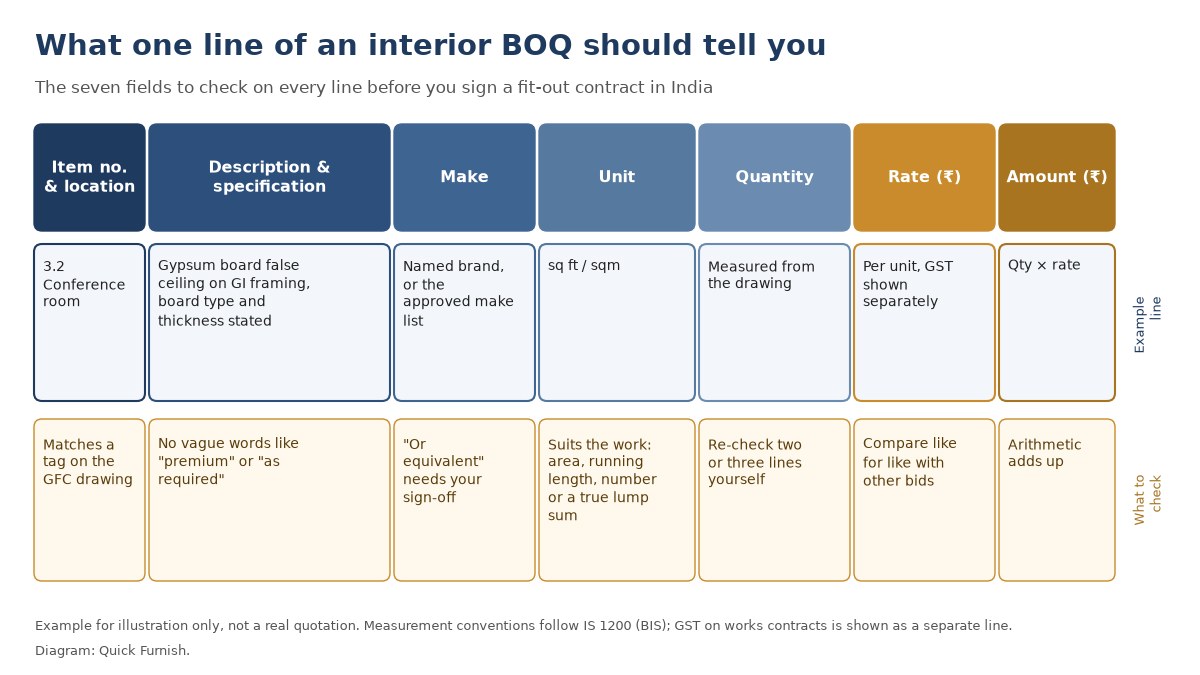
Each section then lists line items. The diagram below shows the seven fields every line should carry.
How do you read a BOQ line by line?
1. Item number and location
Every line should point to a place on the drawing: “3.2, Conference room, false ceiling”. If items are grouped as “civil works, complete” or “miscellaneous”, you cannot check them against the drawings or hold anyone to them.
2. Description and specification
This is where most of the money hides. A good description names the material, thickness, grade and finish. “Gypsum false ceiling” is not enough; the board type, thickness, framing and finish should be stated. Watch for words like “premium”, “standard”, “as required” or “as directed” with nothing behind them.
3. Make or approved make list
Indian BOQs often carry a separate list of approved makes for boards, laminates, paint, wiring, switches, light fittings and HVAC equipment. Check that each line either names a make or refers to that list. “Or equivalent” is normal, but the equivalent should need your written approval.
4. Unit of measurement
Units should suit the work: area for ceilings, flooring and painting; running length for skirting, edge profiles and some pipework; numbers for doors, fittings and points; and lump sum only for things that genuinely cannot be measured. Mixed square feet and square metres across bids make comparisons misleading, so convert everything to one unit (1 m² is about 10.76 sq ft).
5. Quantity
Quantities should come from the drawings, not round guesses. Pick two or three big lines, such as the ceiling area or the number of workstations, and check them yourself against the layout. Under-measured quantities make a quote look cheaper and come back as variations once the site is measured.
6. Rate
The rate is the price per unit. Check whether it includes supply, installation, transport, wastage and scaffolding, and whether GST is included or shown separately. Rates are only comparable when the description, make and unit are the same.
7. Amount
Quantity multiplied by rate. Simple, but check a few lines and the section totals; spreadsheet errors in BOQs are more common than you would think.
What measurement rules apply to an interior BOQ in India?
In India the reference for measuring building work is IS 1200, the Bureau of Indian Standards’ method of measurement of building and civil engineering works. It has separate parts for different trades, including Part 10 (ceilings and linings), Part 11 (paving, floor finishes, dado and skirting) and Part 13 (painting of building surfaces), all revised or reaffirmed in recent years.
A few IS 1200 rules that often matter in office fit-outs:
- Painting is measured net in square metres, and walls, ceilings and sloping surfaces are measured separately (Part 13).
- Small openings are not deducted. Under Part 13, openings up to 0.5 m² each are not deducted from painted areas, and larger openings follow set deduction rules.
- The number of coats and preparatory work must be described in the item, not left for site discussion (Part 13).
- Ceilings are generally measured by area in square metres (Part 10), so a quote in sq ft should convert cleanly.
You do not need to read the standard. Ask your contractor to state in the BOQ that quantities will be measured per IS 1200. On item-rate contracts, where the final bill depends on site measurement, that one line prevents many arguments.
For rate benchmarks, government and many private estimators refer to the CPWD Delhi Schedule of Rates (DSR) 2023, which the Municipal Corporation of Delhi has also adopted for its estimates. DSR rates are written for government civil works, so they are a sense-check for basic items like blockwork, plaster and painting, not a price list for commercial office interiors.
How much should each trade cost in an office BOQ?
The quickest sanity check on any BOQ is its split by trade. JLL’s Asia Pacific Fit-Out Cost Guide 2025 put the Indian office fit-out split at roughly 32% builders’ work (civil, partitions, ceiling, flooring and finishes), 29% M&E services (mechanical and electrical, including HVAC, electrical and fire), 17% security, IT and AV, 16% furniture and 5% professional services.
Applied to Cushman & Wakefield’s 2026 office fit-out cost guide, here is what that split looks like for an 8,000 sq ft office:
| BOQ section (JLL share) | Ahmedabad ₹/sq ft | Ahmedabad, 8,000 sq ft (₹) | Mumbai ₹/sq ft | Mumbai, 8,000 sq ft (₹) |
|---|---|---|---|---|
| Builders’ work (civil, partitions, ceiling, flooring, finishes) | 1,870 | 149.7 lakh | 2,100 | 168.1 lakh |
| M&E services (HVAC, electrical, fire) | 1,700 | 135.7 lakh | 1,900 | 152.4 lakh |
| Security, IT and AV | 990 | 79.5 lakh | 1,120 | 89.3 lakh |
| Furniture | 940 | 74.8 lakh | 1,050 | 84.1 lakh |
| Professional services (design, project management) | 290 | 23.4 lakh | 330 | 26.3 lakh |
| All-in total | 5,847 | 467.8 lakh | 6,567 | 525.4 lakh |
If one trade in your BOQ is far off this pattern, ask why. A low M&E share may mean HVAC or fire work has been left out or assumed to be “by the landlord”. A high furniture share may be fine if you chose imported chairs, but it should be a choice you made, not one you discover. For city-by-city rates in more detail, see our guide to office interior cost per sq ft in India.
Where does GST appear in an interior BOQ?
A turnkey office fit-out is usually a works contract under GST: a contract for building, fitting out, renovating or altering immovable property where goods are transferred in the process. The GST Council’s note on works contract services explains the definition. For commercial fit-outs it is taxed at 18% with input tax credit under SAC 9954, and the September 2025 rate changes did not alter that general rate.
What to check in the BOQ:
- GST is shown as a separate line on the summary, not buried inside rates, so bids can be compared before tax.
- The quote carries the contractor’s GSTIN and the place of supply is your site’s state, which matters if you want to claim input tax credit.
- Loose furniture or equipment supplied separately may be invoiced differently from the works contract. Ask how each part will be billed before you sign.
GST treatment depends on how your contract is structured, so confirm it with your own tax adviser.
Lump-sum, item-rate or per-sq-ft quote: which BOQ should you ask for?
The same BOQ format can sit under very different pricing arrangements. This is the comparison we walk clients through:
| Fixed (lump-sum) BOQ | Item-rate BOQ (re-measured) | Per-sq-ft quote | |
|---|---|---|---|
| How the price works | Agreed total for the scope in the drawings | Agreed rates; final bill = measured quantity × rate | One rate × carpet area |
| Who carries quantity risk | Contractor, within the agreed scope | You: if quantities grow, so does the bill | Unclear until a BOQ is made |
| Best for | Offices with approved GFC drawings | Uncertain scope, such as old buildings or phased work | Early budgeting only |
| What can still change the price | Your design changes, provisional sums, exclusions | Measurement, design changes, provisional sums | Almost everything |
| What to insist on | Full drawings, make list, exclusions in writing | IS 1200 measurement and joint measurement records | A proper BOQ before you sign |
A per-sq-ft figure is useful for a first budget, but it is not something you can sign against. Ask for an itemised BOQ before committing. If you are weighing a single design-and-build contract against hiring separate consultants and contractors, our services page explains how each of our four services works.
What BOQ mistakes do Indian companies make most often?
Run through this checklist before you approve a BOQ:
- Comparing grand totals instead of lines. Line up bids trade by trade, with the same quantities, units and makes.
- Ignoring the exclusions page. Common exclusions are HVAC changes, fire work, landlord deposits, IT cabling, furniture and approval fees. Silence is not inclusion.
- Accepting large provisional sums. A provisional sum (or PC, prime cost, item) is an allowance for something not yet decided. A low allowance lowers the total, not the final cost.
- Letting “or equivalent” go unchecked. Cheaper makes behind identical descriptions are the most common reason one bid is lower.
- Not tying the BOQ to a drawing revision. The BOQ should name the drawing set and revision it was priced on.
- Mixing sq ft and sqm, or carpet and built-up area. Convert to one basis before comparing.
- Forgetting building costs. Grade-A towers in BKC, Cyber City or on SG Highway often have fit-out manuals with their own deposits, working-hour limits and approved vendors. Ask whether these are priced.
- Leaving fire and HVAC to “by others”. These packages sit inside the M&E share and decide whether the office can be occupied. Our guide to the fire NOC for office interiors explains why fire work belongs in the BOQ.
- Skipping the change process. Agree in writing how variations are priced and approved before work starts.
How Quick Furnish prepares and fixes the BOQ
Our process runs in four stages: design, planning and procurement, execution, and handover. The BOQ is produced at the end of design, alongside the GFC drawings, and nothing goes to site until you have approved both. Our city pages describe the same step: “Furniture, finishes and vendors are fixed to it, and nothing goes to site until you have approved the design and the BOQ.”
A recent example is the 40,000 sq ft Bajaj Finserv office in Shyamal, Ahmedabad, which we completed in 60 days on a design and build contract. It was our first pan-India engagement with the brand, and more projects followed. On a programme that tight, the BOQ cannot be a moving target: drawings, quantities and makes have to be locked before procurement so that civil work, MEP, joinery and furniture can run as one programme.
Across 600+ projects in 35+ cities, that is how we work: a test fit, 3D design and a fixed BOQ before procurement, with most office interiors handed over in 6 to 8 weeks. Our Ahmedabad commercial interiors team works from our headquarters, with hubs in Mumbai and Gurgaon for projects across the country.
Want a BOQ you can check line by line? Get a free test fit and quote or call +91 70437 04333.
Key takeaways
- An interior BOQ is the priced version of your drawings; anything not in it has not been paid for and will come back as an extra.
- Every line needs a location, a specific description, a make, a sensible unit, a measured quantity, a rate and an amount.
- Ask for quantities to be measured per IS 1200, and use CPWD DSR only as a sense-check for basic civil items.
- Check the trade split: JLL’s 2025 India figures put builders’ work at about 32%, M&E at 29%, IT and security at 17% and furniture at 16%.
- Commercial fit-out works contracts carry 18% GST with input tax credit; keep it as a separate line.
- Read the exclusions, provisional sums and approved make list before you compare totals.
Frequently asked questions about interior BOQs
What is a BOQ in interior design?
A BOQ, or bill of quantities, is an itemised list of every material and job in an interior project. Each line gives a description, make, unit, quantity, rate and amount, so you can see exactly what you are paying for and compare contractors fairly.
Who prepares the BOQ for an office fit-out?
Usually the interior designer, architect or a quantity surveyor prepares it from the GFC drawings. In a design-and-build contract, the same firm prepares the drawings and the BOQ, which keeps the two consistent.
Is a BOQ the same as a quotation?
Not quite. A quotation can be a single total or a per-sq-ft rate. A BOQ breaks that total into measured, priced items. Always ask for the BOQ behind a quotation before you sign.
Which units are used in an interior BOQ in India?
Area (sq ft or sqm) for ceilings, flooring, partitions and painting; running feet or metres for skirting and profiles; numbers for doors, fittings and points; and lump sum only for items that cannot be measured. IS 1200 sets the measurement rules.
What GST applies to an office interior BOQ?
A commercial office fit-out supplied as a works contract is generally taxed at 18% GST with input tax credit under SAC 9954. Ask for GST as a separate line and confirm the treatment with your tax adviser.
What is a provisional sum in a BOQ?
It is an allowance for work or items not yet fully decided, such as a feature light or AV system. The final cost replaces the allowance, so a low provisional sum can make a bid look cheaper than it really is.
Why do two interior BOQs for the same office differ so much?
Usually because of different makes behind the same description, different quantities, packages left out (often HVAC, fire or IT), or different provisional sums. Compare line by line after aligning scope, units and makes.
Can the BOQ change after work starts?
On a fixed BOQ, the price changes only if you change the design or a provisional item is finalised. On an item-rate BOQ, the bill also follows measured quantities. Either way, every change should be priced and approved in writing first.
Get a test fit and a BOQ you can check line by line
Share your floor area, headcount and move-in date, and within 48 hours we will send you a test fit and a realistic budget per sq ft. When you are ready, we follow it with 3D design and a fixed, itemised BOQ, and you commit only after you have approved both.
Prefer to talk? Call +91 70437 04333 or email info@quickfurnish.co.
This guide reflects IS 1200, the CPWD DSR and GST rules as checked in October 2026. It is general information, not tax or legal advice; confirm the details for your own contract.