
Quick answer: A bare shell office in India comes with only the structure, core and services up to the floor, so you build almost everything. A warm shell adds central AC, power backup and a sprinkler grid. It cuts some fit-out cost and time, but you still build the interior, and your lease’s handover schedule decides what you get.
Most companies meet these terms in a broker’s email, next to a rent figure. The rent gap looks like the decision. It isn’t. What matters is how much fit-out you still pay for, how long the build takes, and whether the landlord’s services suit your layout.
The choice is wider now. JLL reported record gross leasing of 61.06 million sq ft across India’s seven main markets in January to September 2026, and CBRE put new completions for the same period at a record ~51 million sq ft, led by Hyderabad, Bengaluru and Pune. More new supply means more floors to compare and more room to negotiate what the landlord delivers. This guide explains each handover condition, what it does to your fit-out budget, the HVAC and GST points Indian tenants miss, and how to decide before you sign.
What is a bare shell office in India?
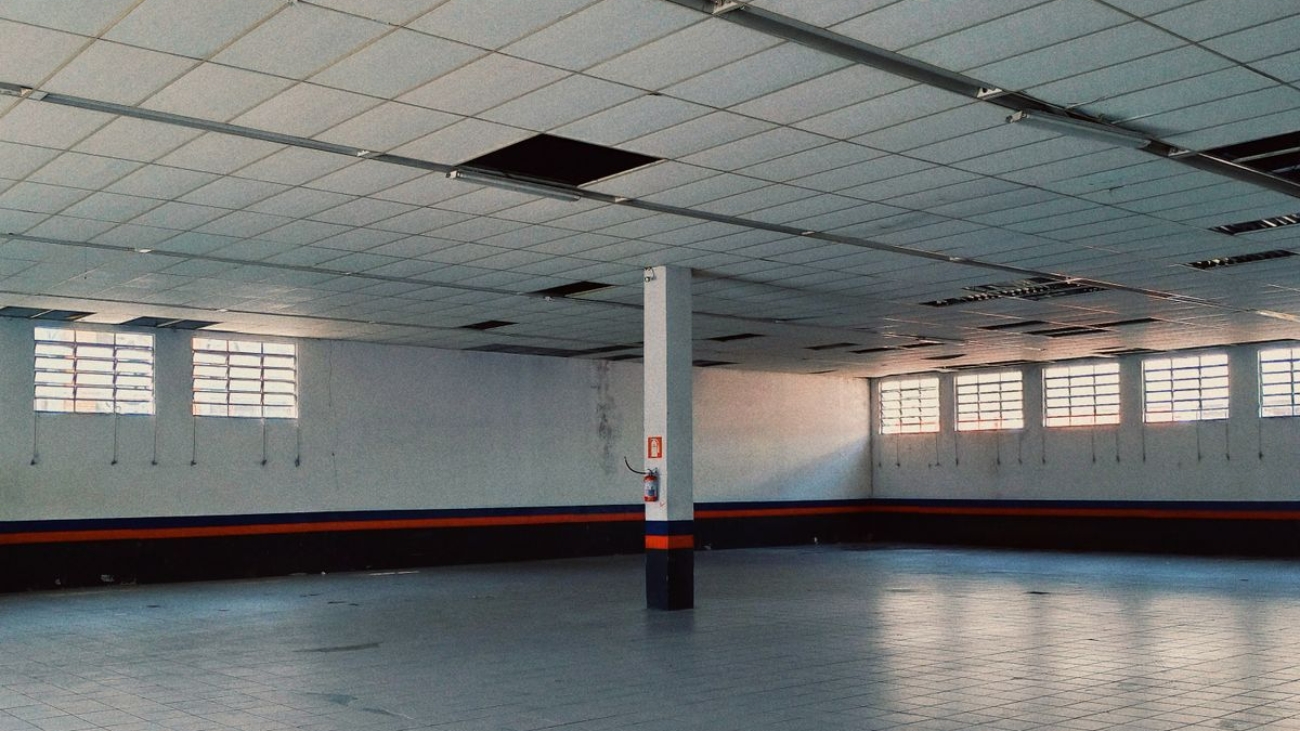
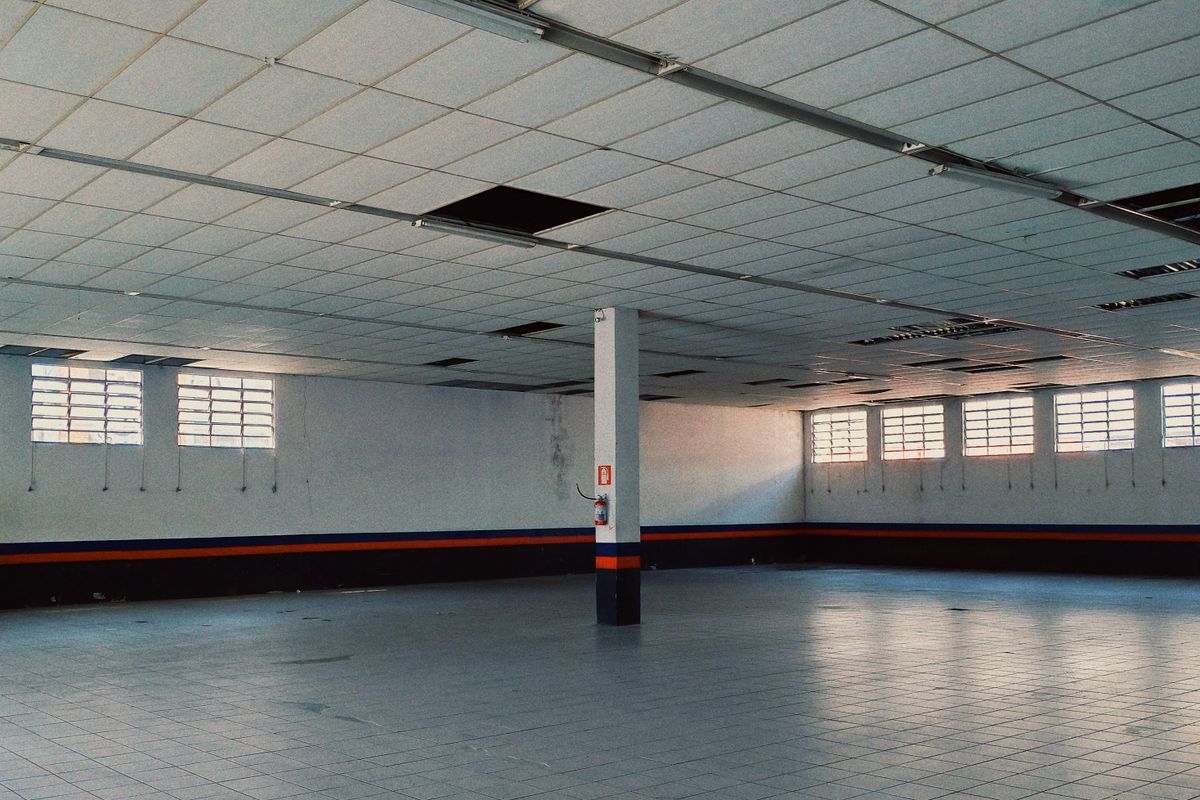
A bare shell floor is the building with nothing inside your premises. The landlord delivers the structure, facade, lifts, staircases, lobbies and usually common washrooms in the core. Services such as power, water, fire mains and chilled water (if the building has a central plant) stop at the riser or the edge of your floor.
Inside your boundary you typically get a raw or screeded slab, plastered or bare walls and no false ceiling, lighting or air-conditioning distribution. Your fit-out contractor builds everything else: ceilings, flooring, partitions, lighting, power and data distribution, AC distribution and often the indoor units, extensions to fire detection and sprinklers, pantry plumbing, and sometimes washrooms inside the floor.
What is a warm shell office, and why does the definition change from building to building?
A warm shell is a bare shell plus some base-building services brought onto your floor. In most Indian Grade-A towers that means the central AC (a chilled-water system with air handling units, or a VRF system with outdoor units installed), power to a floor distribution board with DG backup, a sprinkler and detector grid laid out for an open floor, a screeded floor ready for finishes and finished washrooms in the core.
There is no Indian standard that defines “warm shell”. One landlord may include a grid ceiling and general lighting; another may provide only the AHU room and a chilled-water stub. The only reliable definition is the handover specification attached to your lease or leave and licence agreement: a written list of what the landlord provides, where each service stops, its capacity and its condition.
What does the landlord hand over in a bare shell, warm shell and fully fitted office?
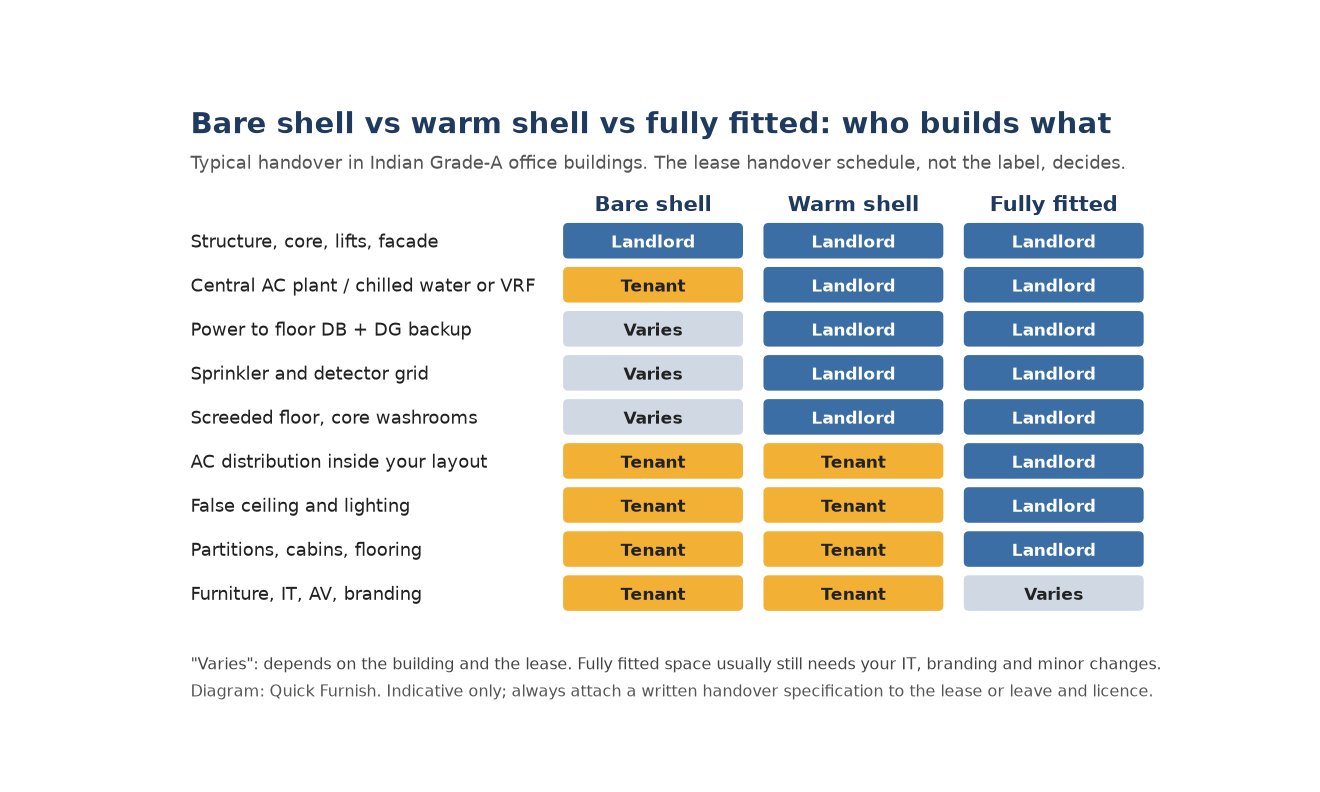
The table below shows the usual split in Indian Grade-A buildings. Use it as a checklist for your handover schedule, not as a promise of what any particular building includes.
| Item | Bare shell | Warm shell | Fully fitted (plug and play) |
|---|---|---|---|
| Structure, core, lifts, facade | Landlord | Landlord | Landlord |
| Central AC plant (chilled water or VRF) | Building plant only; floor connection may be tenant’s | Landlord, with AHU or outdoor units for the floor | Landlord |
| AC ducting and indoor units for your layout | Tenant | Tenant (modify or extend) | Landlord |
| Power to floor DB and DG backup | Supply to riser; backup per kVA varies | Landlord, up to an agreed kVA | Landlord |
| Sprinklers and fire detection | Mains at riser or a basic grid | Open-plan grid; tenant re-routes for rooms | Landlord, for the fitted layout |
| Floor | Raw or screeded slab | Screeded, ready for finish | Finished |
| False ceiling and lighting | Tenant | Tenant (some buildings give a grid) | Landlord |
| Partitions, cabins, meeting rooms | Tenant | Tenant | Landlord, fixed layout |
| Furniture, IT cabling, AV, branding | Tenant | Tenant | Mostly landlord; IT and branding often tenant |
| Typical time to occupy | Longest | Shorter, central plant ready | Days to weeks |
| Design freedom | Full | High, around fixed AC and fire points | Low |
How much does an office fit-out cost on a bare shell vs a warm shell floor?
Start with the full fit-out. Cushman & Wakefield’s 2026 Asia Pacific office fit-out cost guide (December 2025 pricing) puts a mid-spec, all-in office fit-out at ₹5,847 per sq ft in Ahmedabad, Pune, Hyderabad, Chennai and Kolkata, ₹6,027 in Bengaluru, ₹6,207 in Delhi and ₹6,567 in Mumbai. We break those numbers down city by city in our office interior cost per sq ft guide.
JLL’s 2025 fit-out cost guide for India splits a typical fit-out like this: builders’ work 32%, mechanical and electrical (M&E) services 29%, security, IT and AV 17%, furniture 16% and professional services 5%. A warm shell only touches part of one line, M&E. It removes the central plant and the backbone of the fire and power systems from your scope, but not the ducting, indoor units, lighting, power distribution and sprinkler changes that your layout needs. Everything else is yours either way.
| Cost package | Share of a typical India fit-out (JLL 2025) | Bare shell: who pays | Warm shell: who pays |
|---|---|---|---|
| Builders’ work: partitions, ceilings, flooring, joinery | 32% | Tenant | Tenant (floor screed may be landlord’s) |
| M&E: HVAC, electrical, fire, plumbing | 29% | Tenant, including AC distribution and often indoor units | Shared: landlord plant and backbone, tenant distribution and changes |
| Security, IT and AV | 17% | Tenant | Tenant |
| Furniture | 16% | Tenant | Tenant |
| Professional services: design, PMC | 5% | Tenant | Tenant |
So a warm shell saves a share of the M&E budget, not a share of the whole fit-out. How big that share is depends on the building: a floor with working AHUs, a sprinkler grid and DG backup already sized for office density saves far more than one with a chilled-water stub at the riser. Ask your fit-out partner to price your test fit on both floors you are considering. That comparison is worth more than any rule of thumb.
How do the rent-free period and fit-out rent change the comparison?
Landlords in India usually give a fit-out period after handover, during which you pay no rent or a reduced rent while you build. It is negotiated deal by deal, and recent registered leases show how much it varies:
- IBM’s lease of 161,884 sq ft at Embassy Golflinks, Bengaluru, carried a 45-day rent-free fit-out period and a separate fit-out rent of ₹63.09 per sq ft, against a starting rent of ₹150 per sq ft, according to CRE Matrix data reported by Business Standard.
- Eternal’s 84,157 sq ft lease at R Square in Andheri East, Mumbai, gave a fit-out period of 150 days from licence commencement, at a starting rent of ₹160 per sq ft a month.
The arithmetic is simple. On an illustrative 10,000 sq ft floor at ₹100 per sq ft per month, every month of rent-free fit-out is worth ₹10 lakh. A bare shell floor needs a longer build, so it needs a longer fit-out period. If the landlord offers the same 45 days on a bare shell as on a warm shell, the cheaper rent can disappear in the months you pay rent on a floor you cannot use yet. Negotiate the fit-out period from your contractor’s programme, not from the landlord’s standard term sheet.
Where does HVAC go wrong on a warm shell floor?
Air-conditioning is where warm shell saves the most and where it fails most often. The landlord sized the AHUs, supply points and fresh air for a generic open floor. Your layout is rarely generic. Problems we see on Indian fit-outs:
- Cabins and meeting rooms: each closed room needs its own supply, return air and sometimes a separate zone. Open-plan ducting has to be cut, extended or re-balanced.
- Server and hub rooms: they need 24×7 cooling, but central chilled-water plants often run on building hours. You may need a dedicated split or precision unit and the power for it.
- Dense seating: AHUs and fresh air sized for an average density struggle on a packed floor. Check both against your headcount.
- After-hours charges: in chilled-water buildings, running AC outside building hours is usually billed separately. Get the rate in writing if your teams work shifts.
- Sprinklers and detectors: every partition and ceiling change moves sprinkler heads and detectors. Fire and life safety provisions sit in NBC 2016 Part 4, and the changes usually need landlord approval and fresh checks before occupation. We cover this in our fire NOC guide for office fit-outs.
The fix is a test fit before you agree the handover specification. Then ask the landlord to deliver AC points that suit your plan, or to state AHU capacity, fresh air and kVA in writing. HVAC design in buildings is covered by NBC 2016 Part 8 (Building Services), and your consultant should check the landlord’s figures against it.
How does GST treat a bare shell vs a warm shell fit-out?
This is the point most comparisons miss. Rent on commercial property attracts GST at 18%, and a registered business that uses the office for taxable supplies can generally claim input tax credit on it. Fit-out work is different. Under Section 17(5)(c) and (d) of the CGST Act, credit is blocked on works contracts and goods or services used to construct immovable property on your own account, and “construction” includes renovation, additions and alterations to the extent they are capitalised.
The Supreme Court’s Safari Retreats judgment of 3 October 2024 briefly opened an argument that some buildings could be “plant”. Section 124 of the Finance Act, 2025 then replaced “plant or machinery” with “plant and machinery” in Section 17(5)(d), retrospectively from 1 July 2017, which excludes buildings and civil structures. In practice, GST on built-in fit-out work such as partitions, ceilings and flooring is usually a cost to a tenant, while movable furniture and IT equipment are treated differently.
That changes the maths. On a warm shell, the landlord pays for the central AC and services and recovers them through rent, on which you may be able to claim credit. On a bare shell, you pay for more of that work yourself, and GST on the capitalised part may not come back. Ask your CA to review your BOQ split between built-in and movable items before you compare the two floors.
Bare shell or warm shell: which suits your company?
| Your situation | Usually better fit | Why |
|---|---|---|
| Long lease and a large floor | Bare shell | Full design control; capex spread over a long term; more leverage on fit-out period |
| Standard open-plan layout, mid-length lease | Warm shell | Central AC and backup ready; shorter build; less capex |
| Many cabins, labs, server room or heavy pantry | Bare shell, or warm shell with services agreed to your layout | Avoids paying to remove landlord ducting and sprinklers |
| Move-in needed in under 8 weeks | Warm shell or fully fitted | Bare shell builds rarely finish that fast once approvals are included |
| Uncertain headcount, 1–2 year horizon | Fully fitted or managed space | Lowest capex; you pay for it in rent |
| GIFT City, BKC or other Grade-A campus with a strict fit-out manual | Either; read the manual first | Landlord drawing approval and licensed-contractor rules apply in both |
If you are planning a move, our 90-day office relocation checklist shows where the handover decision fits into the lease, design and approval timeline.
Mistakes to avoid when comparing bare shell and warm shell offices
- ☐ Comparing rent only. Compare rent, fit-out cost, fit-out period, time to occupy and GST credit together over the full lease term.
- ☐ Trusting the label. “Warm shell” means different things in different buildings. Get a written handover schedule with drawings.
- ☐ Signing before a test fit. Without one you cannot tell whether AC points, sprinklers and columns suit your headcount and rooms.
- ☐ Not checking capacities. Ask for AHU tonnage, fresh air, kVA allocation and DG backup in writing, not just “AC provided”.
- ☐ Accepting a standard fit-out period. Match it to your contractor’s programme, including landlord drawing approval.
- ☐ Forgetting reinstatement. Check what you must remove or restore at exit. On a bare shell, taking a floor back to shell can be a real cost.
- ☐ Ignoring after-hours AC and CAM. Get extended-hours HVAC rates and maintenance charges in the term sheet.
- ☐ Leaving GST to the end. Have your CA review the BOQ split before you decide.
How Quick Furnish handles bare shell and warm shell floors
Quick Furnish designs and builds offices from bare shell and warm shell floors under one contract, one programme and one point of accountability. Our design and build service covers space planning, 3D design, the BOQ, civil work, ceilings, flooring, partitions, MEP including HVAC modification and fire detection, furniture, snagging and handover. You approve an itemised BOQ before work starts, and any change is priced and approved by you first.
We recommend the test fit before you sign the lease. As our Ahmedabad team puts it, a test fit shows whether the floor can accommodate your headcount and meeting rooms, and what the fit-out will cost, which gives you better leverage when negotiating rent and the landlord’s fit-out contribution. Grade-A towers along SG Highway and in GIFT City need landlord-approved drawings before site work starts, and we survey them against the landlord fit-out manuals first.
Case study: TotalEnergies, Adani Shantigram, Ahmedabad
For TotalEnergies, we delivered a 9,500 sq ft office at Adani Shantigram, Ahmedabad, on a design and build contract within a 6 to 8 week programme. The brief was a clean, well-organised workspace that reflects a global energy brand’s standards, with sleek finishes and smart use of space. A project of that size and pace depends on knowing early what the building provides, so design, procurement and site work can run to one plan.
Comparing two floors? Get a free test fit & quote. Send us the floor plans and handover terms, your headcount and your move-in date. Within 48 hours we will send you a test fit and a realistic budget per sq ft. Contact us or call +91 70437 04333.
Key takeaways
- Bare shell means you build almost everything inside your floor; warm shell adds central AC, power backup and a fire grid, but you still build the interior.
- “Warm shell” has no standard definition in India. The handover schedule in your lease is what counts.
- A warm shell saves part of the M&E budget (29% of a typical India fit-out, per JLL), not a share of the whole fit-out.
- Negotiate the rent-free fit-out period from your contractor’s programme; recent Indian leases range from 45 to 150 days.
- GST on capitalised fit-out work is usually blocked, while GST on rent can generally be claimed, which can tilt the comparison towards warm shell.
- Do a test fit before you sign so you know whether the landlord’s services suit your layout.
Frequently asked questions about bare shell vs warm shell offices
What is the difference between bare shell and warm shell office space?
A bare shell office has only the structure, core and services up to the floor; the tenant builds the ceiling, flooring, AC distribution, lighting, partitions and everything else. A warm shell adds base-building services such as central AC with AHUs or VRF units, power to a floor board with DG backup, a sprinkler grid and a screeded floor. The tenant still builds the interior.
Is warm shell office space more expensive than bare shell?
Warm shell rent is usually higher because the landlord has spent more on the floor. Your fit-out cost is lower, because some M&E work is already done. Compare the total over the lease: rent, fit-out cost, rent-free period, time to occupy and GST credit. Neither is cheaper by default.
How much does it cost to fit out a bare shell office in India?
Cushman & Wakefield’s 2026 guide puts a mid-spec, all-in office fit-out at ₹5,847 to ₹6,567 per sq ft depending on the city, with Mumbai the highest. A bare shell floor sits at the full end of that scope. A warm shell reduces part of the M&E share; get both floors priced on your own test fit.
How long does a bare shell office fit-out take?
Quick Furnish hands over most office interiors in 6 to 8 weeks from design sign-off. Bare shell floors need more M&E work and often longer landlord approvals than warm shell floors, so allow extra time and ask for a fit-out period that matches the programme.
What is a rent-free fit-out period?
It is the time after handover when you build your office without paying rent, or at a reduced fit-out rent. In India it is negotiated per deal. Recent registered leases reported by Business Standard show 45 days for IBM in Bengaluru and 150 days for Eternal in Mumbai.
Can I claim GST input tax credit on my office fit-out?
Usually not on built-in work that you capitalise, such as partitions, ceilings and flooring, because Section 17(5) of the CGST Act blocks credit on construction of immovable property. Movable furniture and IT equipment are treated differently. GST on rent can generally be claimed. Ask your CA to review the BOQ.
What should the handover schedule in my lease include?
It should list what the landlord provides, where each service stops and its capacity: AC type, AHU tonnage and fresh air, kVA allocation and DG backup, sprinkler and detector layout, floor condition, washrooms, and water and drain points for the pantry. Attach drawings, and note who may modify base-building services.
Is warm shell always better for small offices?
Often, but not always. A small office with many cabins, a server room or a large pantry may need so many AC and sprinkler changes that a warm shell saves little. A test fit on the actual floor plan shows how much of the landlord’s work you can keep.
Choosing between a bare shell and a warm shell floor? Share your floor area, headcount and move-in date, along with the landlord’s handover terms, and within 48 hours we will send you a test fit and a realistic budget per sq ft. Get a free test fit & quote, call +91 70437 04333 or email info@quickfurnish.co.
Market figures, lease terms and tax rules in this guide were checked in November 2026 against the named sources. They are guides, not quotes or legal or tax advice. Confirm the handover terms with your landlord and GST treatment with your CA.