
Quick answer: In a turnkey contract, one firm designs and builds your office for an agreed price and carries the coordination risk. In an item-rate contract, you pay fixed rates on measured quantities, so the bill moves with the site. A PMC manages separate vendors for a fee. With a tight move-in date, turnkey gives the most certainty.
Once the lease is signed, most Indian companies face the same question before they face any design question: who do we sign with, and on what terms? The answer decides who pays when the AC ducting clashes with the ceiling or the handover slips past the rent-free period.
This guide compares the three contract models used for office interiors in India: turnkey (design and build), item-rate, and project management consultancy (PMC). It explains what each one means in rupees, which clauses matter (retention, defect liability, liquidated damages, GST), and which model fits which kind of project.
What are turnkey, item-rate and PMC contracts?
Turnkey (design and build)
One firm takes the project from test fit to handover: design, drawings, BOQ (bill of quantities), procurement, civil and MEP (mechanical, electrical and plumbing) work, furniture and snagging. You sign one contract, usually for a fixed price against an approved design and BOQ, and you get one point of accountability. “Turnkey” means you get the keys to a working office, not a set of packages to stitch together.
Item-rate
Your architect or interior designer prepares the drawings and an unpriced BOQ. Contractors quote a rate for every item, and you pay those rates on the quantities actually measured on site. This is the model India’s Central Public Works Department (CPWD) uses for many government works; its General Conditions of Contract 2023 cover both item-rate tenders (form CPWD-8) and percentage-rate tenders (CPWD-7), where bidders quote a percentage above or below an estimated BOQ.
PMC (project management consultancy)
A PMC does not build anything. It acts as your representative: it plans the programme, runs tenders, checks bills, tracks quality and progress, and coordinates the designer and contractors. You still sign separately with each vendor, usually on item-rate or package contracts, and you pay the PMC a fee on top.
The three are not always exclusive. A large company rolling out offices in several cities may hire a PMC to manage a turnkey contractor, while a small team may run an item-rate contract with its architect acting as the de facto project manager.
Turnkey vs item rate contract vs PMC: how do they compare?
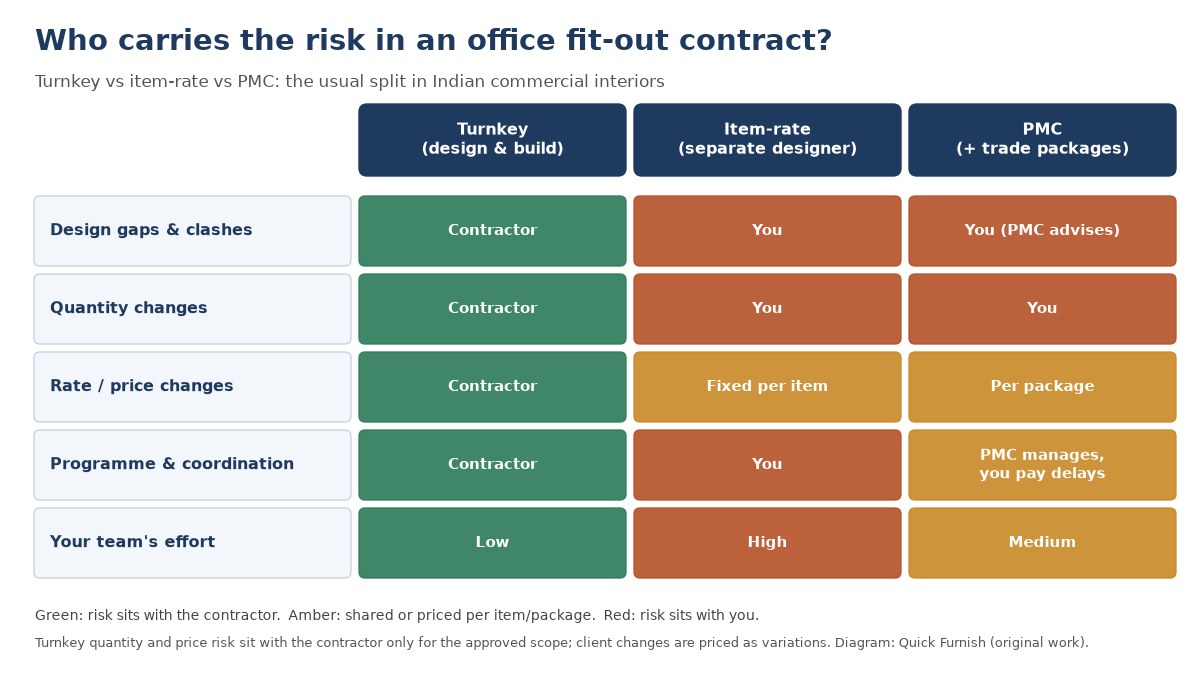
How risk and effort usually split between you and your vendors (exact terms depend on your contract):
| Factor | Turnkey (design and build) | Item-rate | PMC + trade packages |
|---|---|---|---|
| Who designs | The turnkey firm | Your separately hired designer | Your designer; the PMC reviews |
| Contracts you sign | One | Designer + one or more contractors | PMC + designer + several vendors |
| Price basis | Fixed price for an approved design and BOQ | Agreed rate × measured quantity | Package prices plus PMC fee |
| Cost certainty at signing | High, for the approved scope | Medium: quantities can grow | Medium: depends on each package |
| Who pays for design gaps and clashes | The turnkey firm | You (designer and contractor may dispute it) | You, though the PMC should catch them early |
| Variations | Priced and approved before work | Extra items priced at market rates | Priced package by package |
| Programme control | One programme, one firm | You coordinate designer and contractor | The PMC coordinates on your behalf |
| Your team’s effort | Low | High | Medium |
| Best fit | Fixed move-in date, lean admin team | Design fixed early, strong in-house team | Large or multi-site programmes |
How does each contract model affect your office budget?
Start with the size of the money involved. Cushman & Wakefield’s APAC Office Fit-Out Cost Guide 2026 puts a collaborative hybrid office at about ₹5,847 per sq ft in Ahmedabad, Pune, Hyderabad, Chennai and Kolkata, ₹6,027 in Bengaluru, ₹6,207 in Delhi and ₹6,567 in Mumbai. On that benchmark, a 10,000 sq ft office in Ahmedabad is roughly a ₹5.8 crore project, and one in Mumbai roughly ₹6.6 crore. Our city-wise guide to office interior cost per sq ft explains what sits inside those numbers.
At that scale, the contract terms themselves are worth lakhs. The table below applies common Indian contract norms to a ₹1 crore interior contract. The percentages are the ones CPWD’s GCC 2023 uses for government works; private office contracts often follow similar levels, but every figure is negotiable, so check your own draft.
| Term | Typical basis in India | On a ₹1 crore contract |
|---|---|---|
| GST on a commercial works contract | 18% (SAC heading 9954, with input tax credit) | ₹18 lakh |
| Security deposit / retention | 2.5% deducted from running and final bills (CPWD GCC Clause 1A) | ₹2.5 lakh held back |
| Performance guarantee | 5% of tendered value (CPWD GCC Schedule E) | ₹5 lakh bank guarantee |
| Compensation for delay (LD) | Up to 1% per month, capped at 10% (CPWD GCC Clause 2) | Up to ₹1 lakh a month, ₹10 lakh maximum |
| Defect liability period | 12 months from completion; 6 months for works of ₹10 lakh and below (CPWD GCC Clause 17) | Retention released after 12 months |
| Mobilisation advance | Up to 10%, against a bank guarantee of 110% (CPWD GCC) | Up to ₹10 lakh, backed by an ₹11 lakh guarantee |
Where the budget then moves depends on the model:
- Item-rate: the rates are fixed, but the bill follows measured quantities and extra items. Under CPWD’s Clause 12, items not in the contract are priced at market rates with supporting analysis, which is exactly where office fit-out budgets drift.
- Turnkey: the price is fixed for the approved design and BOQ. It moves only when you change the scope, and each change should be priced and approved before work. A good turnkey firm prices its risk into the original number rather than recovering it through extras.
- PMC: you pay a consultancy fee on top of the package prices. The fee can pay for itself if the PMC catches scope gaps and over-billing, but it does not transfer the risk of those gaps away from you.
- Price escalation: in Cushman & Wakefield’s 2026 contractor survey, 77% of India respondents expected their own pricing to rise slightly over the next six months. A contract that locks rates or prices for the programme protects you from that; one with an open escalation clause does not.
Which contract clauses matter most in an Indian office fit-out?
Retention money and security deposit
Retention is a slice of each bill you hold back until the defect liability period ends. CPWD deducts 2.5% from every running and final bill until the full security deposit is collected, and refunds it only after the defect period or the final bill, whichever is later. Agree the percentage, the release trigger, and whether a bank guarantee can replace the cash.
Defect liability period (DLP)
The DLP is the window after handover in which the contractor must fix defects at its own cost. CPWD’s standard is 12 months for larger works and 6 months for works of ₹10 lakh and below. For an office, ask for the DLP in writing, separate from any manufacturer warranties for chairs, AC units or flooring, and make sure the snag list is signed before the clock starts.
Liquidated damages for delay
Most fit-out contracts name a delay charge, typically a percentage per week or month with a cap. In India, Section 74 of the Indian Contract Act, 1872 limits you to reasonable compensation up to the named amount. In Kailash Nath Associates v. DDA (2015), the Supreme Court held that where loss can be proved, it must be proved; the named sum is a ceiling, not an automatic payout. So set an LD that reflects your real cost of delay, such as rent and the cost of staying in your old premises, and keep a record of it.
Variations and extra items
Every contract should say who can order a change, how it is priced, how it affects time, and that nothing is built until the change is approved in writing. CPWD’s Clause 12 extends the completion time in proportion to the extra cost, plus 25%, which is a useful benchmark when a contractor asks for more time after you add scope.
Payment terms
Link stage payments to measurable progress (design sign-off, material delivery, completion of civil, MEP and furniture) rather than to dates alone. If your contractor or vendor is a registered micro or small enterprise, the MSMED Act, 2006 caps agreed payment terms at 45 days from acceptance, and late payment attracts compound interest at three times the RBI bank rate.
GST
A commercial office fit-out supplied as a works contract is generally taxed at 18% GST under SAC heading 9954, with input tax credit available to the recipient subject to the usual conditions. The GST rate changes that took effect on 22 September 2025 did not change this rate for commercial works contracts. Ask for GST as a separate line in the BOQ and confirm the treatment with your tax adviser. The GST Council’s note on works contract services is a useful starting point.
Approvals and statutory scope
Write down who handles the landlord’s fit-out approvals, drawing submissions and fire NOC work, and who pays the building’s fit-out deposit. Fit-outs in India have to keep the base building’s fire and life safety systems compliant with NBC 2016 and the state fire service, and in an item-rate contract this work often falls between the designer and the contractor unless the scope says otherwise.
Which contract suits your office?
Choose turnkey when the date matters most
If you have a fixed move-in date, a rent-free period that is running out, or a lean admin team, turnkey is usually the right call. One firm owns the design, the BOQ and the programme, so a clash between the ceiling and the AC ducting is its problem, not yours. This is common for companies taking a floor in a Grade-A building on SG Highway in Ahmedabad, at BKC or Lower Parel in Mumbai, or on Golf Course Extension Road in Gurgaon, where landlord fit-out manuals and drawing approvals add their own steps.
Choose item-rate when the design is fixed and you have a strong team
Item-rate works when the design is complete before tender, the quantities are reliable, and you have in-house engineers or a trusted architect to measure work and check bills. It suits organisations whose procurement rules require competitive item-wise bids. Our guide to reading an interior BOQ line by line covers the checks you will need.
Choose a PMC when the programme is large or spread across cities
A PMC earns its fee on large headquarters projects, multi-city rollouts, or when your company wants an independent party checking the contractor. It adds a layer of control, not a layer of risk transfer. Many companies combine the two: a PMC on their side, managing a turnkey contractor on the other.
Contract mistakes Indian companies make on office fit-outs
- Comparing a turnkey price with an item-rate estimate. One is a fixed number for a defined scope; the other is an estimate that will be re-measured. Compare like for like.
- Tendering before the design is complete. In an item-rate contract, every gap in the drawings becomes an extra item at market rates.
- Leaving MEP, fire and IT “by others”. These packages decide whether you can occupy the office, and they are the first place where responsibility falls between contracts.
- No written variation process. Verbal site instructions are the most common source of fit-out disputes.
- An LD clause with no link to real loss. Under Section 74, you may recover far less than the named sum if you cannot show what the delay cost you.
- Releasing retention at handover. Hold it until the defect liability period ends and the snag list is closed.
- Ignoring the landlord’s fit-out manual. Working-hour limits, drawing approvals and deposits belong in the programme and the contract, not in an email after work starts.
- Hiring a PMC and assuming the risk has moved. A PMC manages risk for you; it does not carry it.
How Quick Furnish runs a turnkey design and build contract
Our Design & Build service is “a turnkey approach to creating spaces, from design to execution, under one contract”. The work runs in four stages: design, planning and procurement, execution, and handover. You approve a test fit, 3D design and a fixed, itemised BOQ before procurement starts, and any change is priced and approved by you first. If you prefer a different model, we also offer Project Management on its own, and you can hire us for the full project or for any single stage.
A recent example is the 9,500 sq ft TotalEnergies office at Adani Shantigram, Ahmedabad, delivered on a design and build contract in 6 to 8 weeks. The brief was a clean, well-organised office to international standards. One contract covered design, procurement and execution, so one team was answerable for the programme and the finish.
Across 600+ projects in 35+ cities, most of our office interiors are handed over in 6 to 8 weeks. Our commercial interiors team in Ahmedabad works from our headquarters, with hubs in Mumbai and Gurgaon for projects across India.
Weighing turnkey against item-rate for your floor? Get a free test fit and quote or call +91 70437 04333.
Key takeaways
- Turnkey puts design, BOQ and programme under one contract and one fixed price for the approved scope.
- Item-rate fixes rates, not the final bill; quantities and extra items decide what you pay.
- A PMC manages vendors on your behalf for a fee, but the cost and design risk stay with you.
- On a ₹1 crore contract, common Indian terms mean ₹18 lakh GST, ₹2.5 lakh retention and an LD cap of around ₹10 lakh.
- Under Section 74 of the Indian Contract Act, LDs are a ceiling on reasonable compensation, not an automatic payout.
- Hold retention until the defect liability period ends, and agree every variation in writing before work starts.
Frequently asked questions about turnkey and item-rate contracts
What is the difference between a turnkey and an item rate contract?
In a turnkey contract, one firm designs and builds the project for an agreed price and hands it over ready to use. In an item-rate contract, you supply the design, the contractor quotes a rate per item, and you pay those rates on measured quantities, so the final bill can move.
Is a turnkey contract the same as a lump sum contract?
Not exactly. Turnkey describes the scope: one firm delivers a ready-to-use space. Lump sum describes the price: one fixed amount. Most turnkey interior contracts in India are priced as a lump sum or a fixed BOQ for the approved design, but it is worth confirming in writing.
What does a PMC do in an office interior project?
A project management consultant represents you. It plans the programme, runs tenders, coordinates the designer and contractors, checks quality and bills, and reports progress. It does not build, and it does not take on the cost or design risk of the vendors it manages.
Which contract is cheaper for an office fit-out in India?
An item-rate bid often looks cheaper at tender because it is an estimate on drawings that may change. A turnkey price includes design coordination and risk. Compare the expected final cost, including likely extras, PMC fees and your own team’s time, not just the starting number.
What is retention money in an interior contract?
Retention is a part of each bill that you hold back as security until the defect liability period ends. CPWD’s GCC 2023, for example, deducts 2.5% from running and final bills. Private contracts set their own percentage, so agree it before you sign.
What is the usual defect liability period for office interiors?
Twelve months after completion is a common benchmark in India; CPWD uses 12 months for larger works and 6 months for works of ₹10 lakh and below. Product warranties from manufacturers are separate and can run longer.
Are liquidated damages enforceable in India?
Yes, within limits. Section 74 of the Indian Contract Act allows reasonable compensation up to the amount named in the contract. The Supreme Court has held that where actual loss can be proved, it must be proved, so link your LD figure to real costs such as rent.
What GST applies to an interior design and build contract?
A commercial office fit-out supplied as a works contract is generally taxed at 18% GST under SAC heading 9954, with input tax credit available subject to conditions. Confirm the treatment for your contract with your tax adviser.
Get a test fit and a fixed price you can plan around
Share your floor area, headcount and move-in date, and within 48 hours we will send you a test fit and a realistic budget per sq ft. When you are ready, we follow it with 3D design and a fixed, itemised BOQ under one design and build contract, and you commit only after you have approved both.
Prefer to talk? Call +91 70437 04333 or email info@quickfurnish.co.
This guide reflects CPWD’s General Conditions of Contract 2023, the Indian Contract Act, the MSMED Act and GST rules as checked in October 2026. It is general information, not legal or tax advice; have your own contract reviewed before you sign.