
Quick answer: An office snagging checklist is the room-by-room list of defects you inspect, record and get fixed before you accept a fit-out. In India, walk the floor with the contractor, sign a dated snag list, collect test certificates and as-built drawings, and hold back retention, typically 2.5% under CPWD terms, until the defect liability period ends.
Handover week is when office projects lose leverage. The furniture is in, the move date is fixed, the team wants to get in, and the last bill is waiting. This guide explains what snagging covers in an Indian office fit-out, what to check trade by trade, which certificates to collect, how much money sits in retention, and the mistakes that cost companies the most.
What is snagging in an office fit-out?
A snag is a small defect or unfinished item in otherwise complete work: a scratched glass partition, a door that doesn’t close on its own, a dead socket, a ceiling tile out of line. Snagging is the process of finding, listing and fixing those items before the client accepts the space. In Indian contracts you will also hear it called a punch list.
Snagging sits between two milestones. The first is practical completion, when the office can be used for its purpose. CPWD’s General Conditions of Contract 2023 calls this “substantial completion” and records a provisional completion certificate with a list of outstanding items attached. The second is the end of the defect liability period (DLP), the window after completion in which the contractor must still fix defects at its own cost. Snagging is the work at the start of that window, and your signed snag list is the baseline for everything that follows.
What should an office snagging checklist cover?
Walk the office in a fixed order, room by room, and check each trade in turn. Take a photo of every snag, give it a number, a location on the layout and a responsible trade. The checklist below covers a typical Indian office fit-out with workstations, cabins, meeting rooms, a pantry and a server room.
Civil work, partitions and doors
- Gypsum and glass partitions are plumb, joints are taped and invisible after paint, and there are no cracks at ceiling or column junctions.
- Glass is free of scratches and chips, and manifestation (frosted film bands) is at the height shown on the drawing.
- Every door swings freely, latches, and closes fully on its door closer. Fire-rated doors carry their labels and are not wedged or fitted with hold-opens that weren’t approved.
- Locks, keys and access-control cards are labelled room by room.
Ceilings, flooring and finishes
- False ceiling tiles sit flat in the grid, with no sagging, stains or gaps around light fittings, diffusers, sprinkler heads and detectors.
- Access panels are provided below every AC unit, damper and valve that will need servicing.
- Carpet tiles follow the pattern and direction on the drawing, with no lifted edges; vinyl and tile joints are even, and skirting is fixed tight to the wall.
- Paint is a single even colour under raking light, with no patches where other trades worked after painting.
Joinery and furniture
- Workstations match the approved layout and count, with screens, pedestals and wire managers fitted.
- Drawers and shutters open smoothly, laminates and edge bands are not peeling, and hinges are adjusted.
- Chairs, storage units and boardroom tables match the approved samples and specifications in the BOQ (bill of quantities), with no transit damage.
Electrical, lighting and data
- Every power, UPS and data point on the layout works, and each is labelled to its circuit or port.
- Distribution boards are labelled, circuit schedules are pasted inside the door, and residual current devices (RCDs) trip when tested.
- All light fittings work, match in colour temperature, and lighting controls and sensors respond as designed.
- Network points are tested and the server or hub room is cooled, locked and kept clear of storage.
HVAC, fire safety and plumbing
- Every zone holds its set temperature with the floor occupied; there are no hot cabins or draughty desks, and condensate drains don’t drip.
- Fire alarm detectors, sounders and the sprinkler layout match the approved fire drawings after the partitions went in; exit signs are lit and exit routes are clear.
- Pantry sinks, taps and drains run without leaks, and any water heaters or dispensers have isolation valves.
Which documents should you collect at handover?
A clean office isn’t a finished one until the paperwork is in. Ask for a handover pack and tick it off with the same care as the snag list. The core items for an Indian office are:
- As-built drawings for civil, electrical, HVAC, fire and data, showing what was actually built. CPWD’s GCC 2023 (Clause 8A) asks the contractor to submit completion plans within 30 days of completion and sets a penalty if they don’t.
- Electrical test results and self-certification. Under the Central Electricity Authority’s safety regulations of 2023, installations at or below the voltage notified by your state are inspected, tested and self-certified, with the report sent to the Electrical Inspector, before supply starts. The same regulations require an insulation resistance test and RCD protection.
- Fire safety certificates. In Maharashtra, the Fire Prevention and Life Safety Measures Act, 2006 requires a Licensed Agency’s certificate on the fire measures, and a maintenance certificate every January and July. In Gujarat, Fire Safety Certificates are issued and renewed on the Gujarat Fire Safety CoP portal, with six-monthly building inspections by a Fire Safety Officer. Our fire NOC guide covers other states.
- Commissioning records for the AC (air balancing and temperature readings), fire alarm tests and any sprinkler work done during the fit-out.
- Warranties and manuals for AC units, UPS, chairs, flooring, access control and AV, with the start date and the service contact for each.
- Final measurement and reconciliation of the BOQ, including approved variations, so the final bill matches what was built.
- The landlord’s sign-off of the fit-out against its fit-out manual, which often decides when your fit-out deposit comes back.
How much money is at stake at handover?
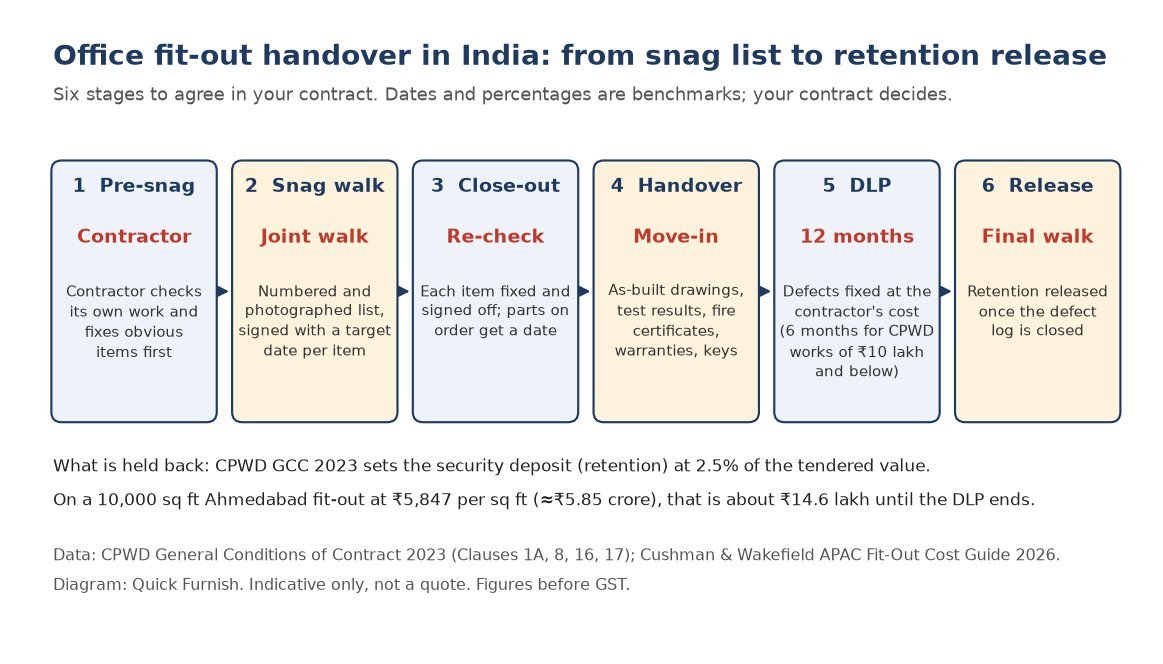
Most Indian fit-out contracts hold back part of each bill as retention (in CPWD terms, the security deposit) until the DLP ends. Some also ask for a performance guarantee, usually a bank guarantee. CPWD’s GCC 2023 sets the security deposit at 2.5% of the tendered value, deducted at 2.5% of each bill, and the performance guarantee at 5%, with 80% of the guarantee returned once the provisional completion certificate is recorded. Private office contracts vary, so read your own, but these are useful benchmarks. Applied to Cushman & Wakefield’s 2026 fit-out costs for a 10,000 sq ft office, the sums look like this:
| City | Fit-out cost (₹/sq ft) | 10,000 sq ft fit-out | 2.5% retention held to end of DLP | 5% performance guarantee |
|---|---|---|---|---|
| Mumbai | ₹6,567 | ₹6.57 crore | ≈₹16.4 lakh | ≈₹32.8 lakh |
| Delhi | ₹6,207 | ₹6.21 crore | ≈₹15.5 lakh | ≈₹31.0 lakh |
| Bengaluru | ₹6,027 | ₹6.03 crore | ≈₹15.1 lakh | ≈₹30.1 lakh |
| Ahmedabad, Pune, Hyderabad, Chennai, Kolkata | ₹5,847 | ₹5.85 crore | ≈₹14.6 lakh | ≈₹29.2 lakh |
That is why snagging matters. Fifteen lakh rupees of retention is the main reason a contractor comes back in month nine to fix a leaking pantry drain. Release it early and you are relying on goodwill.
How long do snagging and the defect liability period take?
There’s no statutory timetable for a private office fit-out, so agree one in the contract. CPWD’s clauses give a sensible pattern. The contractor gives notice within 10 days of completion, and the engineer inspects within 30 days and issues a final completion certificate or a provisional one listing the defects (Clause 8). Defects that appear within 12 months of completion must be fixed at the contractor’s cost, or within 6 months for works of ₹10 lakh and below (Clauses 16 and 17), and the security deposit isn’t refunded before that period ends.
On a typical office programme, the sequence runs like this:
- Contractor’s pre-snag: the contractor walks its own work and fixes the obvious items before inviting you.
- Joint snag walk: you, the contractor’s project manager and, ideally, your IT and admin leads walk the floor together. The list is numbered, photographed and signed with a target date for each item.
- Close-out and re-check: each item is fixed and signed off. Items that need parts, such as a replacement glass panel, get a dated commitment.
- Handover and move-in: the handover pack is checked, keys and cards are issued, and the provisional or final completion is recorded with the open items attached.
- Defect liability period: you log defects as they appear (a shared sheet is enough), and the contractor fixes them within an agreed response time.
- Final inspection: a last walk before the DLP ends, then the retention is released.
Snag, defect or warranty claim: who fixes what?
Three kinds of problem turn up after a fit-out, and each has a different owner. Sorting them early avoids arguments about who pays.
| Snag | Defect in the DLP | Warranty claim | |
|---|---|---|---|
| When it appears | At or before handover | After handover, within the DLP (often 12 months) | Within the manufacturer’s warranty period |
| Typical example | Chipped laminate, misaligned ceiling tile, dead socket | Cracked partition joint, leaking pantry drain, door closer failing | AC compressor, UPS battery or chair mechanism failing |
| Who fixes it | The fit-out contractor, before final sign-off | The fit-out contractor, at its cost | The manufacturer or its service partner, usually coordinated by the contractor during the DLP |
| Your leverage | Unpaid final bill | Retention or performance guarantee | Warranty card and invoice |
| What to record | Signed, photographed snag list | Dated defect log and notice to the contractor | Warranty start date, serial numbers, service contact |
Wear and tear is excluded from all three. Damage caused by other contractors you bring in later, such as an AV vendor drilling through a partition, is also yours to manage. So keep your own vendors on the contractor’s work permits and get them to note existing damage before they start.
Office snagging mistakes Indian companies make
Use this as a final checklist before you sign the completion certificate.
- Snagging an empty office. AC balance, acoustics and lighting glare only show up with people and equipment in. Do a second check in the first two weeks of occupation.
- Unsigned or vague snag lists. “Fix paint in cabin” invites argument. Write the location, the defect and the fix, and attach a photo.
- Releasing retention at handover. Hold it, or a bank guarantee in its place, until the DLP ends and the defect log is closed.
- Accepting the office without as-built drawings. The next refit, a landlord audit or a fire inspection will need them, and they are hardest to get once the team has left the site.
- Skipping the fire layout check after partitions. New walls and cabins move the detector and sprinkler layout. Make sure the fire drawings were updated and the work matches them.
- Letting IT and AV vendors arrive after handover without a record. Note who damaged what, or every scratch becomes the fit-out contractor’s problem and its dispute.
- No owner for the DLP. Name one person in admin or facilities to log defects and chase close-outs for the full period.
- Forgetting the landlord. If the building’s fit-out manual requires its own completion inspection, book it early. It can hold up your fit-out deposit refund and sometimes the move-in.
How Quick Furnish handles snagging and handover
Handover is the fourth stage of the Quick Furnish process, after design, planning and procurement, and execution. In our words: “We fix all snags (small defects) and hand over the final drawings and warranties. We cover the defect liability period and stay available long after the final invoice is paid.” Because one team builds the civil work, MEP (mechanical, electrical and plumbing), joinery and furniture under one design-and-build contract, the snag list has one owner instead of five trades pointing at each other.
Our Go Digit project in Nehru Place, Delhi shows why that matters. The 14,500 sq ft office first had to be demolished before the new interior could go in, on a very demanding deadline and with structural constraints. The team took it from safe demolition to a complete interior build within the deadline. It was part of more than 60,000 sq ft delivered for Digit across India, and Digit then gave us its next office in Hyderabad. See the Go Digit project.
Older Delhi buildings like those in Nehru Place and Connaught Place often mean working around ageing building services, which is exactly where snag lists grow. Our Delhi team works from the Gurgaon office, and the same project manager stays with you from survey to final snagging and as-built drawings. Most office interiors are handed over in 6 to 8 weeks.
Get a free test fit & quote: share your floor area, headcount and move-in date, and within 48 hours we will send you a test fit and a realistic budget per sq ft. Request your test fit or call +91 70437 04333.
Key takeaways
- Snagging is the inspection and fixing of small defects before you accept the office; the signed snag list is the baseline for the defect liability period.
- Check trade by trade (civil, ceilings, flooring, joinery, electrical, HVAC, fire, plumbing), then do a second check once the office is occupied.
- Collect as-built drawings, electrical self-certification and test results, fire certificates, commissioning records and warranties before final payment.
- Under CPWD benchmarks, 2.5% retention on a 10,000 sq ft fit-out is roughly ₹14.6 to ₹16.4 lakh, and it should be held until the DLP ends.
- A 12-month DLP is the common benchmark (6 months for CPWD works of ₹10 lakh and below). Name one person to run the defect log.
- For the contract terms behind all of this, see our guide to turnkey and item-rate contracts.
Frequently asked questions about office snagging in India
What is an office snagging checklist?
It is a room-by-room list of the defects and unfinished items found when you inspect a completed office fit-out, such as damaged glass, dead sockets, misaligned ceiling tiles or doors that don’t close. Each item is numbered, photographed, assigned to a trade and signed off once fixed, before you accept the office and release the final payment.
Who should attend the snag walk?
The contractor’s project manager, your project lead, and ideally your admin or facilities head and IT lead, since they will live with the space. On larger offices, the designer or a project management consultant often leads the walk. Keep the group small enough to move room by room and agree each item on the spot.
What is the defect liability period for office interiors in India?
It is set by your contract. Twelve months from completion is the common benchmark: CPWD’s General Conditions of Contract 2023 use 12 months, or 6 months for works costing ₹10 lakh and below. During that period the contractor must fix defects caused by poor materials or workmanship at its own cost.
How much retention should I hold on an interior contract?
CPWD deducts a security deposit at 2.5% of each bill, up to 2.5% of the tendered value, and holds it until the defect liability period ends. Private contracts vary, so agree the percentage, the release date and whether a bank guarantee can replace the cash before work starts.
What is the difference between a snag and a defect?
In practice, a snag is found at or before handover and fixed before final sign-off. A defect shows up after handover, during the defect liability period, and the contractor fixes it under the contract. Items covered by a manufacturer’s warranty, such as AC compressors or chair mechanisms, go to the manufacturer.
Which certificates should I get when an office fit-out is handed over?
Ask for as-built drawings, electrical test results and the self-certification report under the CEA safety regulations of 2023, fire alarm and sprinkler test records, any state fire certificates (in Maharashtra, Form A and the six-monthly Form B), AC commissioning records, and warranties and manuals for equipment and furniture.
Should I hire an independent snagging inspector?
It helps when the contract is large, when you have no in-house facilities team, or when several contractors worked on the floor. An independent consultant or PMC brings a checklist and has no stake in the result. On a single turnkey contract, a careful joint walk with your own admin and IT leads is often enough.
How long does office snagging take?
It depends on the size of the floor and how much the contractor fixed in its own pre-snag. Closing the list takes longer when parts such as glass panels must be ordered. Plan it into the last stage of the programme, before move-in. Quick Furnish hands over most office interiors in 6 to 8 weeks, with snagging and as-built drawings included.
Planning a fit-out and want handover done properly? Share your floor area, headcount and move-in date, and within 48 hours we will send you a test fit and a realistic budget per sq ft. Get a free test fit & quote, call +91 70437 04333 or email info@quickfurnish.co.
Contract clauses, regulations and costs in this guide were checked in November 2026 against the named sources. They are benchmarks, not legal advice; your own contract and state rules decide the details.